Urbanization: Difference between revisions
CSV import |
CSV import |
||
| Line 60: | Line 60: | ||
[[Category:Urbanization]] | [[Category:Urbanization]] | ||
<gallery> | |||
File:CityPop_PercUrban-2018.png|Urbanization | |||
File:Guangzhou_dusk_panorama.jpg|Urbanization | |||
File:Mumbai_skyline.jpg|Urbanization | |||
File:Ho_Chi_Minh_City_Skyline_(night).jpg|Urbanization | |||
File:Urbanization_over_the_past_500_years_(Historical_sources_and_UN_(1500_to_2016)),_OWID.svg|Urbanization | |||
File:ArchaeoGLOBE_URBAN.gif|Urbanization | |||
File:Rural_flight.jpg|Urbanization | |||
File:Chicago_Downtown_Aerial_View.jpg|Urbanization | |||
File:Crowded_BTS_Asok_Station.jpg|Urbanization | |||
File:Gross_domestic_product_per_capita_and_level_of_urbanization.svg|Urbanization | |||
File:Patterns_of_urbanization.svg|Urbanization | |||
File:The_African_and_Asian_belts_of_least_urbanized_countries.png|Urbanization | |||
</gallery> | |||
Revision as of 11:02, 18 February 2025
Urbanization
Urbanization refers to the increasing population of people living in urban areas compared to rural areas. It is a process that has been ongoing for centuries and is a key feature of economic development and modernization.
History
Urbanization began with the Industrial Revolution in the 18th century, which led to the growth of cities as centers of manufacturing and commerce. The trend accelerated in the 20th century with advancements in transportation and communication.
Causes
Several factors contribute to urbanization, including:
- Economic opportunities: Cities offer more jobs and higher wages.
- Education and healthcare: Urban areas often provide better access to education and healthcare services.
- Infrastructure: Improved infrastructure in cities attracts people from rural areas.
Effects
Urbanization has both positive and negative effects:
- Positive:
 * Economic growth and innovation.
 * Improved access to services and amenities.
- Negative:
 * Overcrowding and pollution.
 * Strain on resources and infrastructure.
Global Trends
According to the United Nations, more than half of the world's population now lives in urban areas. This trend is expected to continue, with significant urban growth in Asia and Africa.
Challenges
Urbanization poses several challenges, including:
- Sustainable development: Balancing growth with environmental sustainability.
- Social inequality: Addressing disparities in wealth and access to services.
- Urban planning: Managing the growth of cities to prevent sprawl and congestion.
Related pages
References
- United Nations. "World Urbanization Prospects: The 2018 Revision." Retrieved from https://population.un.org/wup/
- Davis, M. (2006). "Planet of Slums." London: Verso.
- Sassen, S. (2001). "The Global City: New York, London, Tokyo." Princeton University Press.
Gallery
-
 Percentage of urban population by country in 2018.
 -
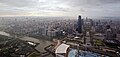 Panorama of Guangzhou at dusk.
 -
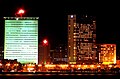 Skyline of Mumbai.
 -
 Business center of Moscow.
 -
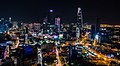 Ho Chi Minh City skyline at night.
 -
 Urbanization over the past 500 years.
 -
 Historical urbanization patterns.
 -
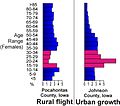 Example of rural flight.
 -
 Aerial view of downtown Chicago.
 -
 Crowded BTS Asok Station in Bangkok.
 -
 GDP per capita and urbanization levels.
 -
 Patterns of urbanization.
 -
 Cities with over 1 million inhabitants in 2020.
 -
 Least urbanized countries in Africa and Asia.


.jpg)
,_OWID.svg)


-
Urbanization
-
Urbanization
-
Urbanization
-
Urbanization
-
Urbanization
-
Urbanization
-
Urbanization
-
Urbanization
-
Urbanization
-
Urbanization
-
Urbanization
-
Urbanization
