Tube feet: Difference between revisions
CSV import |
CSV import |
||
| Line 46: | Line 46: | ||
[[Category:Echinoderm anatomy]] | [[Category:Echinoderm anatomy]] | ||
<gallery> | |||
File:Sea_urchin_Tube_feet_extended_past_the_Spines.jpg|Tube feet of a sea urchin extended past the spines | |||
File:Podia_de_Colobocentrotus_atratus.JPG|Podia of Colobocentrotus atratus | |||
File:Star_Fish_Tube_Feet.jpg|Tube feet of a starfish | |||
File:T._gratilla_podia.jpg|Podia of T. gratilla | |||
File:T._gratilla_podia_(1).jpg|Podia of T. gratilla | |||
File:Mithrodia_clavigera_bras.jpg|Tube feet of Mithrodia clavigera | |||
File:Pycnopodia_helianthoides_on_glass.jpg|Pycnopodia helianthoides on glass | |||
File:Pycnopodiahelianthoides-tubefeet.jpg|Tube feet of Pycnopodia helianthoides | |||
File:Holothuria_forskali_Rab2011_l_4213.JPG|Tube feet of Holothuria forskali | |||
</gallery> | |||
Revision as of 12:07, 18 February 2025
Tube Feet


Tube feet are small, flexible, hollow appendages found in echinoderms, such as sea stars, sea urchins, and sea cucumbers. These structures are part of the water vascular system, a hydraulic system unique to echinoderms, which facilitates movement, feeding, and respiration.
Structure
Tube feet are typically composed of an internal ampulla and an external podium. The ampulla is a bulb-like structure that resides within the body cavity, while the podium extends outside the body. The podium is often equipped with a sucker at its distal end, allowing the organism to adhere to surfaces.

The movement of tube feet is controlled by the water vascular system. Water is pumped into the ampulla, causing it to contract and extend the podium. When the podium is extended, the sucker can attach to a surface. By coordinating the extension and retraction of multiple tube feet, echinoderms can move across the substrate.
Function
Tube feet serve several functions in echinoderms:
- Locomotion: By extending and retracting their tube feet, echinoderms can move across the ocean floor. This is particularly evident in sea stars, which use their tube feet to "walk."
- Feeding: Tube feet can assist in feeding by helping to open shells of prey, such as bivalves, or by transporting food particles to the mouth.
- Respiration: In some echinoderms, tube feet also play a role in gas exchange, allowing oxygen to diffuse into the body and carbon dioxide to diffuse out.
- Attachment: The suckers on tube feet allow echinoderms to adhere to surfaces, providing stability in turbulent waters.
Examples

.jpg)
- Sea Stars: Sea stars, or starfish, have hundreds of tube feet located on their underside. These tube feet are used for locomotion and feeding.
- Sea Urchins: Sea urchins have tube feet that extend past their spines. These tube feet help in movement and in securing the urchin to surfaces.
- Sea Cucumbers: Sea cucumbers use their tube feet primarily for locomotion and feeding. Some species have modified tube feet around their mouth that function as tentacles.
Related Pages
-
 Tube feet of a sea urchin extended past the spines
 -
 Podia of Colobocentrotus atratus
 -
 Tube feet of a starfish
 -
 Podia of T. gratilla
 -
 Podia of T. gratilla
 -
 Tube feet of Mithrodia clavigera
 -
 Pycnopodia helianthoides on glass
 -
 Tube feet of Pycnopodia helianthoides
 -
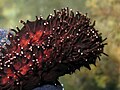 Tube feet of Holothuria forskali


