Umbilical vein: Difference between revisions
CSV import |
CSV import |
||
| Line 32: | Line 32: | ||
[[Category:Embryology]] | [[Category:Embryology]] | ||
[[Category:Obstetrics]] | [[Category:Obstetrics]] | ||
<gallery> | |||
File:Gray502.png|Umbilical vein | |||
File:Gray977.png|Umbilical vein | |||
File:Gray31.png|Umbilical vein | |||
File:Gray458.png|Umbilical vein | |||
File:Gray476.png|Umbilical vein | |||
File:Gray475.png|Umbilical vein | |||
File:Gray1115.png|Umbilical vein | |||
File:Umbilical_vein.jpg|Umbilical vein | |||
File:Slide1MINI.JPG|Umbilical vein | |||
</gallery> | |||
Latest revision as of 11:21, 18 February 2025
Vein present during fetal development
Umbilical vein[edit]
The umbilical vein is a vital component of the fetal circulatory system, responsible for transporting oxygenated blood from the placenta to the growing fetus. This vein is a crucial part of the umbilical cord, which connects the fetus to the placenta.
Anatomy[edit]
The umbilical vein originates from the placenta, where it collects oxygen-rich blood. It travels through the umbilical cord, entering the fetal body at the umbilicus. Once inside the fetus, the umbilical vein ascends towards the liver, where it bifurcates into two branches. One branch joins the portal vein, while the other forms the ductus venosus, which bypasses the liver and connects directly to the inferior vena cava.

Function[edit]
The primary function of the umbilical vein is to deliver oxygenated blood from the placenta to the fetus. This blood is rich in nutrients and oxygen, essential for fetal development. The umbilical vein plays a critical role in maintaining the fetal oxygen supply, as the fetus does not breathe air and relies entirely on the placenta for oxygen exchange.
Closure after birth[edit]
After birth, the umbilical vein closes as part of the transition from fetal to neonatal circulation. The closure is a physiological process that occurs when the umbilical cord is clamped and cut. The remnant of the umbilical vein becomes the ligamentum teres hepatis, a fibrous cord in the liver.
Clinical significance[edit]
In some medical procedures, such as exchange transfusions, the umbilical vein can be accessed for intravenous therapy in newborns. This is due to its size and accessibility shortly after birth.
Related pages[edit]
References[edit]
- Moore, Keith L.; Persaud, T.V.N. (2003). The Developing Human: Clinically Oriented Embryology. Saunders. ISBN 0-7216-9412-8.
- Sadler, T.W. (2012). Langman's Medical Embryology. Lippincott Williams & Wilkins. ISBN 978-1-4511-4460-9.
-
 Umbilical vein
 -
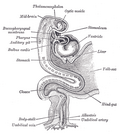 Umbilical vein
 -
 Umbilical vein
 -
 Umbilical vein
 -
 Umbilical vein
 -
 Umbilical vein
 -
 Umbilical vein
 -
 Umbilical vein
 -
 Umbilical vein


