Velocity: Difference between revisions
CSV import Tags: mobile edit mobile web edit |
CSV import |
||
| Line 72: | Line 72: | ||
[[Category:Physics]] | [[Category:Physics]] | ||
[[Category:Kinematics]] | [[Category:Kinematics]] | ||
<gallery> | |||
File:US_Navy_040501-N-1336S-037_The_U.S._Navy_sponsored_Chevy_Monte_Carlo_NASCAR_leads_a_pack_into_turn_four_at_California_Speedway.jpg|U.S. Navy sponsored Chevy Monte Carlo NASCAR at California Speedway | |||
File:Velocity_vs_time_graph.svg|Velocity vs Time Graph | |||
File:Kinematics.svg|Kinematics Diagram | |||
File:Radial_and_tangential.svg|Radial and Tangential Components | |||
</gallery> | |||
Latest revision as of 04:45, 18 February 2025
Velocity[edit]

Velocity is a vector quantity that refers to "the rate at which an object changes its position." It is a fundamental concept in physics and is essential in the study of kinematics. Unlike speed, which is a scalar quantity, velocity includes both the magnitude and the direction of motion.
Definition[edit]
Velocity is defined as the rate of change of displacement with respect to time. Mathematically, it is expressed as:
- \( \mathbf{v} = \frac{d\mathbf{s}}{dt} \)
where \( \mathbf{v} \) is the velocity, \( \mathbf{s} \) is the displacement, and \( t \) is time.
Types of Velocity[edit]
Constant Velocity[edit]
When an object moves with constant velocity, it covers equal displacements in equal intervals of time, regardless of how small these intervals may be. This implies that both the speed and direction of the object remain unchanged.
Variable Velocity[edit]
Variable velocity occurs when either the speed or the direction of the object changes. This can be further classified into:
- Uniformly Accelerated Motion: When the velocity of an object changes at a constant rate.
- Non-uniformly Accelerated Motion: When the velocity changes at a variable rate.
Velocity vs. Speed[edit]

While speed is a scalar quantity that only considers the magnitude of motion, velocity is a vector quantity that considers both magnitude and direction. For example, if a car travels at 60 km/h to the north, its speed is 60 km/h, but its velocity is 60 km/h north.
Mathematical Representation[edit]
Velocity can be represented graphically using a velocity-time graph. The slope of a velocity-time graph represents the acceleration of the object.
Applications[edit]
Velocity is crucial in various fields such as engineering, astronomy, and sports. In engineering, it helps in designing vehicles and predicting their performance. In astronomy, it is used to calculate the orbits of celestial bodies.
Related Concepts[edit]

See Also[edit]
References[edit]
- Halliday, D., Resnick, R., & Walker, J. (2013). Fundamentals of Physics. Wiley.
- Serway, R. A., & Jewett, J. W. (2018). Physics for Scientists and Engineers. Cengage Learning.
Related Pages[edit]


-
 U.S. Navy sponsored Chevy Monte Carlo NASCAR at California Speedway
 -
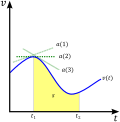 Velocity vs Time Graph
 -
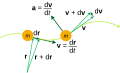 Kinematics Diagram
 -
 Radial and Tangential Components
