Ulnar veins: Difference between revisions
CSV import |
CSV import |
||
| Line 39: | Line 39: | ||
[[Category:Veins of the upper limb]] | [[Category:Veins of the upper limb]] | ||
<gallery> | |||
File:2134_Thoracic_Upper_Limb_Veins.jpg|Ulnar veins | |||
File:Gray575.png|Ulnar veins | |||
File:Slide16III.JPG|Ulnar veins | |||
File:Slide22III.JPG|Ulnar veins | |||
</gallery> | |||
Revision as of 05:01, 18 February 2025
Veins of the upper limb
Ulnar veins
The ulnar veins are venous structures located in the upper limb. They are part of the venous system that drains blood from the forearm and hand back to the heart.
Anatomy
The ulnar veins are typically paired and run alongside the ulnar artery. They originate from the deep venous plexus of the hand and ascend along the ulnar side of the forearm. These veins are responsible for draining the medial aspect of the forearm and hand.
Course
The ulnar veins begin at the superficial palmar arch and travel proximally, accompanying the ulnar artery. They receive blood from the deep veins of the hand and forearm, including the anterior interosseous vein. As they ascend, they join with the radial veins to form the brachial veins near the cubital fossa.
Tributaries
The ulnar veins receive several tributaries along their course, including the anterior interosseous vein and small veins from the surrounding muscles and tissues.
Function
The primary function of the ulnar veins is to return deoxygenated blood from the forearm and hand to the heart. They play a crucial role in the venous return from the upper limb, working in conjunction with the radial veins and superficial veins such as the cephalic vein and basilic vein.
Clinical significance
The ulnar veins, like other deep veins, can be involved in conditions such as deep vein thrombosis (DVT). Although less common in the upper limb than in the lower limb, DVT in the ulnar veins can occur and may require medical intervention.
Images
-
 Diagram of the veins of the upper limb, including the ulnar veins.
 -
 Anatomical illustration showing the ulnar veins in relation to the ulnar artery.
 -
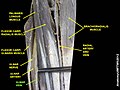 Cross-section of the forearm showing the ulnar veins.
 -
 Detailed view of the ulnar veins in the forearm.


Related pages
References
- Moore, Keith L.; Dalley, Arthur F.; Agur, Anne M. R. (2013). Clinically Oriented Anatomy. 7th edition. Lippincott Williams & Wilkins. ISBN 978-1-4511-1945-9.
- Standring, Susan (2015). Gray's Anatomy: The Anatomical Basis of Clinical Practice. 41st edition. Elsevier. ISBN 978-0-7020-5230-9.
-
Ulnar veins
-
Ulnar veins
-
Ulnar veins
-
Ulnar veins
