Trillium sessile: Difference between revisions
CSV import |
CSV import |
||
| Line 40: | Line 40: | ||
[[Category:Flora of the United States]] | [[Category:Flora of the United States]] | ||
[[Category:Plants described in 1753]] | [[Category:Plants described in 1753]] | ||
<gallery> | |||
File:Trillium_recurvatum_(left)_and_Trillium_sessile_(right)_side-by-side.jpg|Trillium recurvatum (left) and Trillium sessile (right) side by side | |||
File:Trillium_sessile,_2021-04-20,_Seldom_Seen,_05.jpg|Trillium sessile, 2021-04-20, Seldom Seen | |||
File:Single_dark_trillium_sessile_trillium_flower_blooms_with_green_leaves_growing_on_old_log.jpg|Single dark Trillium sessile flower blooms with green leaves growing on old log | |||
</gallery> | |||
Revision as of 04:18, 18 February 2025
Species of flowering plant
Trillium sessile, commonly known as the toadshade or sessile trillium, is a species of flowering plant in the family Melanthiaceae. It is native to the central and eastern United States, where it is found in rich, deciduous woodlands.
Description
Trillium sessile is a perennial herbaceous plant that grows from a rhizome. The plant typically reaches a height of 15 to 30 cm (6 to 12 inches). The leaves are sessile, meaning they are attached directly to the stem without a petiole. Each plant has three broad, ovate leaves that are mottled with shades of green and brown.
The flower of Trillium sessile is characterized by its maroon or dark red petals, which are erect and do not open widely. The flower is sessile, sitting directly on the leaves without a stalk. The sepals are green and lanceolate, and the petals are typically 3 to 5 cm long.
Habitat and distribution
Trillium sessile is found in rich, moist, deciduous forests, often on slopes and in ravines. Its range extends from Minnesota and Wisconsin in the north, south to Alabama and Mississippi, and east to Ohio and West Virginia.
Ecology
The plant is an important part of the forest understory, providing early spring blooms that attract pollinators such as flies and beetles. The seeds of Trillium sessile are dispersed by ants, a process known as myrmecochory.
Conservation
While Trillium sessile is not currently listed as threatened or endangered, its habitat is subject to pressures from deforestation and urban development. Conservation efforts focus on preserving its natural woodland habitat.
Gallery
-
 Trillium sessile in bloom
 -
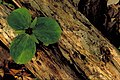 A single Trillium sessile flower


Related pages
References
- Case, F. W., & Case, R. B. (1997). Trilliums. Timber Press.
- Gleason, H. A., & Cronquist, A. (1991). Manual of Vascular Plants of Northeastern United States and Adjacent Canada. New York Botanical Garden.
-
 Trillium recurvatum (left) and Trillium sessile (right) side by side
 -
Trillium sessile, 2021-04-20, Seldom Seen
-
Single dark Trillium sessile flower blooms with green leaves growing on old log
_and_Trillium_sessile_(right)_side-by-side.jpg)
