Paul Lauterbur: Difference between revisions
CSV import |
CSV import Tags: mobile edit mobile web edit |
||
| Line 53: | Line 53: | ||
``` | ``` | ||
{{nt}} | {{nt}} | ||
== Paul Lauterbur == | |||
<gallery> | |||
File:Paul_Lauterbur_2003_cropped.jpg|Paul Lauterbur 2003 | |||
File:PaulLauterbursGroup1976.jpg|Paul Lauterbur's Group 1976 | |||
File:Bush6NobelLaureates.jpg|Bush with 6 Nobel Laureates | |||
</gallery> | |||
Revision as of 23:59, 24 February 2025
Paul Lauterbur
| Birth date | 1929-05-06 |
|---|---|
| Birth place | Sidney, Ohio, USA |
| Died | March 27, 2007 (aged 77) |
| Place of death | Urbana, Illinois, USA |
| Nationality | American |
| Known for | Magnetic Resonance Imaging (MRI) |
| Awards | Nobel Prize in Physiology or Medicine (2003) |
Paul Christian Lauterbur (May 6, 1929 – March 27, 2007) was an American chemist who made significant contributions to the field of medical imaging. He is best known for his pioneering work in the development of Magnetic Resonance Imaging (MRI), a technique that revolutionized medical diagnostics.
Early Life and Education
Paul Lauterbur was born in Sidney, Ohio. He attended Case Institute of Technology (now part of Case Western Reserve University), where he earned a bachelor's degree in chemistry. He later obtained his PhD in chemistry from the University of Pittsburgh.
Career and Research
Lauterbur's early research focused on nuclear magnetic resonance (NMR) spectroscopy, a technique used to determine the structure of molecules. While working at the State University of New York at Stony Brook, he developed the idea of using NMR to create images of the body's internal structures, leading to the invention of Magnetic Resonance Imaging (MRI).
Development of MRI
In 1971, Lauterbur published a seminal paper in the journal Nature describing the principles of MRI. His work demonstrated how magnetic field gradients could be used to generate two-dimensional images, a breakthrough that laid the foundation for modern MRI technology.
Awards and Recognition
Paul Lauterbur received numerous awards for his contributions to medical imaging, including the Nobel Prize in Physiology or Medicine in 2003, which he shared with Peter Mansfield. The award recognized their discoveries concerning MRI, which have had a profound impact on medical diagnostics and patient care.
Personal Life
Lauterbur was married to Joan Dawson, a fellow scientist, and they had two children. He passed away in Urbana, Illinois in 2007.
Legacy
Paul Lauterbur's work on MRI has saved countless lives by enabling early detection and treatment of diseases. His contributions to medical science continue to influence research and clinical practice worldwide.
See Also
References
- Lauterbur, Paul C.,
 Image Formation by Induced Local Interactions: Examples Employing Nuclear Magnetic Resonance,
 Nature,
 1973,
 Vol. 242(Issue: 5394),
 pp. 190–191,
 DOI: 10.1038/242190a0,
The Nobel Prize in Physiology or Medicine 2003(link). {{{website}}}. Nobel Prize.
External Links
```
Paul Lauterbur
-
 Paul Lauterbur 2003
 -
Paul Lauterbur's Group 1976
-
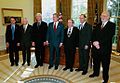 Bush with 6 Nobel Laureates


