Pubis (bone): Difference between revisions
CSV import |
CSV import |
||
| Line 58: | Line 58: | ||
[[Category:Skeletal system]] | [[Category:Skeletal system]] | ||
[[Category:Orthopedics]] | [[Category:Orthopedics]] | ||
== Pubis (bone) == | |||
<gallery> | |||
File:Pelvic_girdle_illustration.svg|Pelvic girdle illustration | |||
File:Gray241.png|Gray's Anatomy illustration 241 | |||
File:Skeletal_pelvis-pubis.svg|Skeletal pelvis pubis | |||
File:Gray235.png|Gray's Anatomy illustration 235 | |||
File:Gray236.png|Gray's Anatomy illustration 236 | |||
File:Gray237.png|Gray's Anatomy illustration 237 | |||
File:Gray321.png|Gray's Anatomy illustration 321 | |||
File:Gray404.png|Gray's Anatomy illustration 404 | |||
File:Gray436.png|Gray's Anatomy illustration 436 | |||
File:Gray341.png|Gray's Anatomy illustration 341 | |||
File:Slide16A.JPG|Slide 16A | |||
</gallery> | |||
Latest revision as of 21:27, 23 February 2025
Pubis (bone)
The pubis is one of the three principal bones that make up the pelvis. It is located in the anterior part of the pelvic girdle and plays a crucial role in supporting the weight of the upper body when sitting and standing, as well as providing attachment points for various muscles.
Anatomy[edit]
The pubis is divided into three main parts:
Body of Pubis[edit]
The body of the pubis is the central portion of the bone. It is flattened and forms the wide, medial part of the pubic bone. The body of the pubis articulates with the bodies of the ischium and ilium to form the acetabulum, which is the socket for the femur in the hip joint.
Superior Ramus[edit]
The superior ramus of the pubis extends laterally from the body of the pubis. It contributes to the formation of the acetabulum and the obturator foramen. The superior ramus is important for the attachment of the pectineus muscle.
Inferior Ramus[edit]
The inferior ramus of the pubis extends downward and laterally from the body of the pubis. It joins with the inferior ramus of the ischium to form the ischiopubic ramus. This structure provides attachment for the adductor magnus and gracilis muscles.
Function[edit]
The pubis serves several important functions in the human body:
- Support: It helps support the weight of the upper body when sitting and standing.
- Protection: It protects the pelvic organs, including parts of the urinary bladder, reproductive organs, and the distal part of the large intestine.
- Muscle Attachment: It provides attachment points for muscles involved in movement of the thigh and stabilization of the pelvis.
Clinical Significance[edit]
Fractures[edit]
Fractures of the pubis can occur due to trauma, such as in a car accident or a fall. These fractures can be painful and may require surgical intervention depending on the severity and displacement of the fracture.
Osteitis Pubis[edit]
Osteitis pubis is an inflammation of the pubic symphysis and surrounding muscle insertions. It is often seen in athletes and can cause pain in the groin and lower abdomen.
Symphysis Pubis Dysfunction[edit]
Symphysis pubis dysfunction (SPD) is a condition that can occur during pregnancy, where the ligaments that normally keep the pubic symphysis stable become too relaxed and stretchy, causing pain and instability in the pelvic region.
Development[edit]
The pubis, along with the ischium and ilium, begins to ossify from cartilage during fetal development. The three bones are separate at birth but gradually fuse together during adolescence to form the mature pelvis.
See Also[edit]

Pubis (bone)[edit]
-
 Pelvic girdle illustration
 -
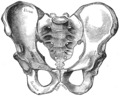 Gray's Anatomy illustration 241
 -
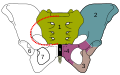 Skeletal pelvis pubis
 -
Gray's Anatomy illustration 235
-
Gray's Anatomy illustration 236
-
Gray's Anatomy illustration 237
-
Gray's Anatomy illustration 321
-
Gray's Anatomy illustration 404
-
Gray's Anatomy illustration 436
-
Gray's Anatomy illustration 341
-
Slide 16A


