Lateral medullary syndrome: Difference between revisions
CSV import Tags: mobile edit mobile web edit |
CSV import |
||
| Line 49: | Line 49: | ||
{{Neurology-stub}} | {{Neurology-stub}} | ||
== Lateral medullary syndrome == | |||
<gallery> | |||
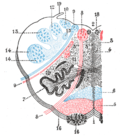
File:Gray700.png|Lateral medullary syndrome | |||
File:WallenbergInfarct001.jpg|Lateral medullary syndrome | |||
File:CerebellumArteries.jpg|Lateral medullary syndrome | |||
File:Human brainstem blood supply description.JPG|Lateral medullary syndrome | |||
</gallery> | |||
Revision as of 01:45, 20 February 2025
Lateral Medullary Syndrome
Lateral Medullary Syndrome, also known as Wallenberg's syndrome, is a neurological condition caused by a stroke in the lateral part of the medulla oblongata in the brainstem. This syndrome is characterized by a variety of symptoms due to the disruption of several neural pathways and cranial nerve nuclei.
Etiology
Lateral Medullary Syndrome is most commonly caused by an occlusion of the posterior inferior cerebellar artery (PICA) or the vertebral artery. This leads to ischemia and infarction in the lateral medulla.
Pathophysiology
The lateral medulla contains several important structures, including:
- The spinothalamic tract, which carries pain and temperature sensations from the body.
- The trigeminal nerve nucleus, which carries sensory information from the face.
- The vestibular nuclei, which are involved in balance and eye movements.
- The inferior cerebellar peduncle, which connects the cerebellum to the brainstem.
- The nucleus ambiguus, which controls muscles involved in swallowing and speech.
When the blood supply to these areas is interrupted, it results in the characteristic symptoms of the syndrome.
Clinical Features
Patients with Lateral Medullary Syndrome may present with:
- Ipsilateral Horner's syndrome: Due to disruption of the sympathetic pathways, leading to ptosis, miosis, and anhidrosis.
- Contralateral loss of pain and temperature sensation: Due to damage to the spinothalamic tract.
- Ipsilateral loss of pain and temperature sensation on the face: Due to involvement of the trigeminal nerve nucleus.
- Dysphagia and dysarthria: Resulting from damage to the nucleus ambiguus.
- Vertigo, nausea, and vomiting: Due to involvement of the vestibular nuclei.
- Ataxia: Resulting from damage to the inferior cerebellar peduncle.
Diagnosis
Diagnosis of Lateral Medullary Syndrome is primarily clinical, supported by imaging studies such as MRI or CT scan of the brain, which can reveal infarction in the lateral medulla.
Management
Management of Lateral Medullary Syndrome involves:
- Acute stroke management: Including thrombolysis if the patient presents within the appropriate time window.
- Supportive care: Such as swallowing therapy for dysphagia and physical therapy for ataxia.
- Symptomatic treatment: For vertigo and pain.
Prognosis
The prognosis of Lateral Medullary Syndrome varies depending on the extent of the infarction and the timeliness of treatment. Some patients may recover significantly with rehabilitation, while others may have persistent deficits.
See Also
Categories
Lateral medullary syndrome
-
 Lateral medullary syndrome
 -
 Lateral medullary syndrome
 -
 Lateral medullary syndrome
 -
 Lateral medullary syndrome


