Arthur Wellesley, 1st Duke of Wellington: Difference between revisions
CSV import |
CSV import |
||
| Line 48: | Line 48: | ||
[[Category:People of the Napoleonic Wars]] | [[Category:People of the Napoleonic Wars]] | ||
[[Category:People from Dublin]] | [[Category:People from Dublin]] | ||
<gallery> | |||
File:Sir_Arthur_Wellesley,_1st_Duke_of_Wellington.png|Sir Arthur Wellesley, 1st Duke of Wellington | |||
File:Dangan_Castle,_Co_Meath,_Ireland,_1840.jpg|Dangan Castle, Co Meath, Ireland, 1840 | |||
File:Dcastlemaindoor.jpg|Dangan Castle Main Door | |||
File:Arthur_Wellesley_by_John_Hoppner.jpg|Arthur Wellesley by John Hoppner | |||
File:Arthur_Wellesley,_1st_Duke_of_Wellington_by_Robert_Home.jpg|Arthur Wellesley, 1st Duke of Wellington by Robert Home | |||
File:Battle_of_Assaye.jpeg|Battle of Assaye | |||
File:Major-General_the_Hon._Arthur_Wellesley_being_received_in_durbar_at_the_Chepauk_Palace_Madras_by_Azim_al-Daula_Nawab_of_the_Carnatic_18th_February_1805.jpg|Major-General the Hon. Arthur Wellesley being received in durbar at the Chepauk Palace Madras by Azim al-Daula Nawab of the Carnatic 18th February 1805 | |||
File:Wellingtons33rd.jpg|Wellington's 33rd | |||
</gallery> | |||
Latest revision as of 23:52, 24 February 2025
Arthur Wellesley, 1st Duke of Wellington (1 May 1769 – 14 September 1852) was a British Army soldier and statesman who is one of the leading military and political figures of 19th-century Britain. He is best known for his victory against Napoleon Bonaparte at the Battle of Waterloo in 1815.
Early Life[edit]
Arthur Wellesley was born in Dublin, Ireland, into the Anglo-Irish aristocracy. He was the third of five surviving sons of Garret Wesley, 1st Earl of Mornington, and Anne Hill-Trevor, the eldest daughter of Arthur Hill-Trevor, 1st Viscount Dungannon.
Military Career[edit]
Wellesley began his military career in 1787, serving in the British Army. He rose to prominence during the Peninsular War (1807–1814) in Spain and Portugal, where he led the British forces to several victories against the French Empire.
Battle of Waterloo[edit]
The Battle of Waterloo was fought on 18 June 1815 near Waterloo, Belgium. It marked the final defeat of Napoleon Bonaparte, ending his rule as Emperor of the French and the Napoleonic Wars. Wellington's leadership was instrumental in the allied victory.
Political Career[edit]
After his military success, Wellington entered politics. He served twice as Prime Minister of the United Kingdom, from 1828 to 1830 and again in 1834. He was a member of the Tory Party and later the Conservative Party.
Legacy[edit]
Wellington is remembered as one of Britain's greatest military commanders. His strategies and tactics are studied in military academies around the world. He was also known for his political conservatism and opposition to Parliamentary reform.
See Also[edit]
References[edit]
- Richard,
 Wellington: The Iron Duke,

 HarperCollins,
 2002,


 ISBN 978-0007137503,
- Elizabeth,
 Wellington: The Years of the Sword,

 Harper & Row,
 1969,


 ISBN 978-0060125350,
External Links[edit]
-
 Sir Arthur Wellesley, 1st Duke of Wellington
 -
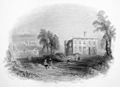 Dangan Castle, Co Meath, Ireland, 1840
 -
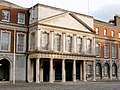 Dangan Castle Main Door
 -
 Arthur Wellesley by John Hoppner
 -
 Arthur Wellesley, 1st Duke of Wellington by Robert Home
 -
 Battle of Assaye
 -
 Major-General the Hon. Arthur Wellesley being received in durbar at the Chepauk Palace Madras by Azim al-Daula Nawab of the Carnatic 18th February 1805
 -
 Wellington's 33rd


