Stem rust: Difference between revisions
CSV import |
CSV import Tags: mobile edit mobile web edit |
||
| Line 50: | Line 50: | ||
[[Category:Fungal plant pathogens and diseases]] | [[Category:Fungal plant pathogens and diseases]] | ||
[[Category:Cereal diseases]] | [[Category:Cereal diseases]] | ||
<gallery> | |||
File:Stem_rust_close_up.jpg|Close-up of stem rust on wheat | |||
File:Modell_von_Puccinia_graminis_(Getreiderost)_-Osterloh-_-Brendel_10_h,_2-.jpg|Model of Puccinia graminis (stem rust) | |||
File:Stem_rust_on_differential_lines_wheat.jpg|Stem rust on differential lines of wheat | |||
File:Puccina_graminis_lifecycle.gif|Lifecycle of Puccinia graminis | |||
</gallery> | |||
Latest revision as of 05:00, 18 February 2025
Stem Rust[edit]
Stem rust, also known as black rust, is a significant fungal disease that affects cereal crops, particularly wheat, barley, and rye. It is caused by the fungus Puccinia graminis, which has a complex life cycle involving two hosts and several spore stages. Stem rust is notorious for its ability to cause severe yield losses in susceptible crops, making it a major concern for agriculture worldwide.
Life Cycle[edit]
The life cycle of Puccinia graminis is heteroecious, meaning it requires two different host plants to complete its life cycle. The primary host is cereal crops, while the alternate host is typically a species of the genus Berberis (barberry).
Spore Stages[edit]
1. Urediniospores: These are the repeating spores that spread the infection during the growing season. They are produced on the cereal host and can reinfect the same host, leading to multiple cycles of infection.
2. Teliospores: These are thick-walled spores that form at the end of the growing season. They overwinter on the cereal host and germinate in the spring to produce basidiospores.
3. Basidiospores: These spores infect the alternate host, Berberis. They are produced from the germination of teliospores.
4. Aeciospores: These are produced on the alternate host and can infect the cereal host, completing the cycle.
Symptoms[edit]
Stem rust is characterized by the appearance of reddish-brown pustules on the stems, leaves, and sometimes the heads of infected plants. These pustules contain urediniospores, which are responsible for spreading the disease. As the disease progresses, the pustules turn black as teliospores develop.
Economic Impact[edit]
Stem rust can cause significant yield losses, particularly in susceptible wheat varieties. In severe cases, it can lead to total crop failure. The disease has historically caused major epidemics, such as the one in the United States in the 1950s, which led to the development of resistant wheat varieties.
Management Strategies[edit]
1. Resistant Varieties: The development and use of resistant wheat varieties is one of the most effective strategies for managing stem rust.
2. Cultural Practices: Removing the alternate host, Berberis, can help break the life cycle of the fungus and reduce the incidence of the disease.
3. Fungicides: The application of fungicides can help control stem rust, especially in areas where resistant varieties are not available.
Recent Developments[edit]
In recent years, new races of stem rust, such as Ug99, have emerged, which can overcome the resistance of many previously resistant wheat varieties. This has renewed interest in breeding for resistance and developing integrated management strategies.
Also see[edit]
-
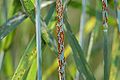 Close-up of stem rust on wheat
 -
 Model of Puccinia graminis (stem rust)
 -
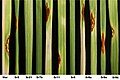 Stem rust on differential lines of wheat
 -
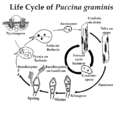 Lifecycle of Puccinia graminis

_-Osterloh-_-Brendel_10_h,_2-.jpg)


