Jasmonate: Difference between revisions
CSV import |
CSV import Tags: mobile edit mobile web edit |
||
| Line 48: | Line 48: | ||
[[Category:Plant physiology]] | [[Category:Plant physiology]] | ||
[[Category:Signal transduction]] | [[Category:Signal transduction]] | ||
== Jasmonate == | |||
<gallery> | |||
File:Jasminum_grandiflorum.jpg|Jasminum grandiflorum | |||
File:Jasmonic_acid_structure.png|Structure of Jasmonic Acid | |||
File:methyl_jasmonate_skeletal.svg|Skeletal structure of Methyl Jasmonate | |||
File:Snap,_Digest,_Absorb_-_How_the_Venus_flytrap_processes_prey_01.png|Venus flytrap processing prey | |||
File:JA_signal.jpg|Jasmonate signaling | |||
</gallery> | |||
Latest revision as of 04:34, 18 February 2025
Jasmonate refers to a class of plant hormones that are derived from fatty acids and play crucial roles in plant growth, development, and defense mechanisms. These compounds are collectively known as jasmonates and include jasmonic acid (JA) and its derivatives such as methyl jasmonate (MeJA) and jasmonoyl-isoleucine (JA-Ile).
Structure and Biosynthesis[edit]
Jasmonates are synthesized from linolenic acid, a polyunsaturated fatty acid found in the chloroplast membranes. The biosynthesis of jasmonates involves several enzymatic steps:
- Lipoxygenase (LOX): This enzyme catalyzes the oxygenation of linolenic acid to form 13-hydroperoxylinolenic acid.
- Allene Oxide Synthase (AOS): Converts 13-hydroperoxylinolenic acid into an unstable allene oxide.
- Allene Oxide Cyclase (AOC): Cyclizes the allene oxide to form 12-oxo-phytodienoic acid (OPDA).
- OPDA Reductase (OPR): Reduces OPDA to form jasmonic acid.
Jasmonic acid can be further modified to form various derivatives, including methyl jasmonate and jasmonoyl-isoleucine, which are active forms involved in signaling.
Functions[edit]
Jasmonates are involved in a wide range of plant processes:
- Defense Responses: Jasmonates are key regulators of plant defense against herbivores and pathogens. They activate the expression of defense-related genes and the production of secondary metabolites that deter herbivores and inhibit pathogen growth.
- Growth Regulation: Jasmonates influence various aspects of plant growth, including root growth, seed germination, and fruit ripening.
- Reproductive Development: They play a role in flower development and fertility, affecting processes such as pollen production and ovule development.
- Stress Responses: Jasmonates help plants respond to abiotic stresses such as drought, salinity, and mechanical wounding.
Signal Transduction[edit]
The perception and signal transduction of jasmonates involve several key components:
- JAZ Proteins: Jasmonate ZIM-domain (JAZ) proteins are repressors that inhibit the expression of jasmonate-responsive genes. In the presence of jasmonates, JAZ proteins are ubiquitinated and degraded, allowing the transcription of target genes.
- COI1: Coronatine-insensitive 1 (COI1) is an F-box protein that forms part of the SCF (Skp, Cullin, F-box) complex, which targets JAZ proteins for degradation.
- MYC Transcription Factors: These are basic helix-loop-helix (bHLH) transcription factors that activate the expression of jasmonate-responsive genes once JAZ repression is lifted.
Applications[edit]
Jasmonates have practical applications in agriculture and horticulture:
- Pest Management: Methyl jasmonate can be used to induce plant defenses, reducing the need for chemical pesticides.
- Post-Harvest Treatment: Jasmonates can delay senescence and extend the shelf life of fruits and vegetables.
Research and Future Directions[edit]
Ongoing research aims to further elucidate the complex signaling networks involving jasmonates and their interactions with other plant hormones such as auxins, gibberellins, and salicylic acid. Understanding these interactions can lead to improved crop resilience and productivity.
Also see[edit]
| Plant hormones |
|---|
|
|
Jasmonate[edit]
-
 Jasminum grandiflorum
 -
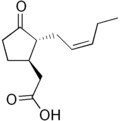 Structure of Jasmonic Acid
 -
 Skeletal structure of Methyl Jasmonate
 -
 Venus flytrap processing prey
 -
 Jasmonate signaling


