Carbohydrazide: Difference between revisions
CSV import |
CSV import |
||
| Line 52: | Line 52: | ||
[[Category:Corrosion inhibitors]] | [[Category:Corrosion inhibitors]] | ||
[[Category:Water treatment]] | [[Category:Water treatment]] | ||
<gallery> | |||
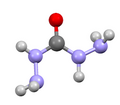
File:Carbohydrazide.png|Carbohydrazide | |||
File:OC(N2H3)2.png|OC(N2H3)2 | |||
</gallery> | |||
Latest revision as of 02:11, 17 February 2025
A chemical compound used in various industrial applications
| Chemical Compound | |
|---|---|
| Identifiers | |
| CAS Number | |
| PubChem CID | |
| ChemSpider ID | |
| UNII | |
| ChEBI | |
| ChEMBL | |
| Properties | |
| Chemical Formula | |
| Molar Mass | |
| Appearance | |
| Density | |
| Melting Point | |
| Boiling Point | |
| Hazards | |
| GHS Pictograms | [[File:|50px]] |
| GHS Signal Word | |
| GHS Hazard Statements | |
| NFPA 704 | [[File:|50px]] |
| References | |
Carbohydrazide is a chemical compound with the formula CO(N₂H₃)₂. It is a white, water-soluble solid that is used in various industrial applications, particularly as a corrosion inhibitor and oxygen scavenger in boiler systems.
Structure and Properties[edit]
Carbohydrazide is a derivative of hydrazine and carbonic acid. It is a crystalline solid at room temperature and has a melting point of approximately 153 to 154 °C. The compound is highly soluble in water, which makes it suitable for use in aqueous systems.
Applications[edit]
Carbohydrazide is primarily used as an oxygen scavenger in boiler water treatment. It reacts with dissolved oxygen to form water and nitrogen gas, thus preventing corrosion in boiler systems. This property makes it an effective alternative to hydrazine, which is more toxic.
In addition to its use in water treatment, carbohydrazide is also employed in the synthesis of pharmaceuticals, polymers, and agricultural chemicals. It serves as a building block for various chemical reactions due to its reactive hydrazide groups.
Safety and Handling[edit]
While carbohydrazide is less toxic than hydrazine, it should still be handled with care. It can cause irritation to the skin, eyes, and respiratory tract. Proper personal protective equipment, such as gloves and goggles, should be used when handling the compound.
Also see[edit]

<references group="" responsive="1"></references>
-
 Carbohydrazide
 -
 OC(N2H3)2

2.png)
