Bismuth telluride: Difference between revisions
CSV import |
CSV import |
||
| Line 49: | Line 49: | ||
[[Category:Bismuth compounds]] | [[Category:Bismuth compounds]] | ||
[[Category:Tellurium compounds]] | [[Category:Tellurium compounds]] | ||
== Bismuth telluride gallery == | |||
<gallery> | |||
File:Монокристалл теллурида висмута.jpg|Monocrystal of bismuth telluride | |||
File:Bi2Te3 structure 2.png|Bi2Te3 structure | |||
File:Twin in Bi2Te3 3.jpg|Twin in Bi2Te3 | |||
</gallery> | |||
Latest revision as of 06:15, 3 March 2025
Bismuth telluride is a compound of bismuth and tellurium, with the chemical formula Bi₂Te₃. It is a gray powder that is a well-known thermoelectric material, used in power generation and refrigeration applications.
Properties[edit]
Bismuth telluride is a narrow bandgap semiconductor with a bandgap of approximately 0.15 eV. It crystallizes in a rhombohedral lattice structure and is known for its high thermoelectric efficiency. The material exhibits a high Seebeck coefficient, low thermal conductivity, and moderate electrical conductivity, making it ideal for thermoelectric applications.
Applications[edit]
Bismuth telluride is primarily used in thermoelectric devices, which convert temperature differences into electrical voltage or vice versa. These devices are used in a variety of applications, including:
- Thermoelectric generators (TEGs): Used to convert waste heat into electrical power, often in industrial settings or in space applications.
- Thermoelectric coolers (TECs): Used for electronic cooling, such as in computer processors or laser diodes.
Synthesis[edit]
Bismuth telluride can be synthesized through several methods, including:
- Zone melting: A process that involves melting a small region of a solid and moving it along the material to purify it.
- Bridgman-Stockbarger technique: A method of crystal growth used to produce single crystals of semiconductors.
- Chemical vapor deposition (CVD): A process used to produce high-purity, high-performance solid materials.
Thermoelectric Performance[edit]
The performance of bismuth telluride as a thermoelectric material is often characterized by its dimensionless figure of merit, ZT, which is defined as:
- ZT = \( \frac{S^2 \sigma T}{\kappa} \)
where:
- \( S \) is the Seebeck coefficient,
- \( \sigma \) is the electrical conductivity,
- \( T \) is the absolute temperature,
- \( \kappa \) is the thermal conductivity.
Bismuth telluride typically exhibits a ZT value of around 1 at room temperature, which is considered high for thermoelectric materials.
Environmental and Safety Considerations[edit]
While bismuth telluride is not considered highly toxic, it should be handled with care to avoid inhalation or ingestion. Proper safety protocols should be followed when working with this material.
Also see[edit]
Template:Thermoelectric materials Template:Semiconductors
Bismuth telluride gallery[edit]
-
 Monocrystal of bismuth telluride
 -
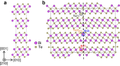 Bi2Te3 structure
 -
 Twin in Bi2Te3


