Diethyltryptamine: Difference between revisions
CSV import |
CSV import |
||
| Line 42: | Line 42: | ||
{{medicine-stub}} | {{medicine-stub}} | ||
== Diethyltryptamine == | |||
<gallery> | |||
File:Diethyltryptamine.svg|Diethyltryptamine | |||
File:DET-3d-sticks.png|Diethyltryptamine | |||
</gallery> | |||
Latest revision as of 01:00, 20 February 2025


Diethyltryptamine (DET) is a synthetic psychedelic compound belonging to the tryptamine class. It is chemically related to the naturally occurring dimethyltryptamine (DMT) and is known for its psychoactive properties.
Chemical Structure and Properties[edit]
Diethyltryptamine is a derivative of tryptamine, with two ethyl groups attached to the nitrogen atom of the indole ring. Its chemical formula is C14H20N2, and it has a molecular weight of 216.33 g/mol. The structure of DET is similar to that of other tryptamines, such as psilocybin and serotonin.
Pharmacology[edit]
DET acts primarily as a serotonin receptor agonist, particularly at the 5-HT2A receptor. This interaction is believed to be responsible for its psychedelic effects. The compound is known to induce altered states of consciousness, including visual and auditory hallucinations, changes in perception, and altered thought processes.
History and Use[edit]
Diethyltryptamine was first synthesized in the mid-20th century and has been studied for its psychoactive effects. It has been used in both clinical research and recreational settings. However, due to its potent effects and potential for abuse, DET is classified as a controlled substance in many countries.
Legal Status[edit]
The legal status of DET varies by country. In the United States, it is classified as a Schedule I controlled substance under the Controlled Substances Act, making it illegal to manufacture, buy, possess, or distribute without a DEA license. Other countries have similar regulations in place.
Safety and Risks[edit]
The use of DET can pose several risks, including psychological distress, anxiety, and potential for abuse. There is limited research on the long-term effects of DET use, and its safety profile is not well-established. Users are advised to exercise caution and be aware of the legal implications of possessing and using this substance.
Related Compounds[edit]
DET is part of a broader class of tryptamines, which includes:
See Also[edit]
References[edit]
<references group="" responsive="1"></references>
External Links[edit]
Template:Psychedelics, dissociatives, and deliriants

Diethyltryptamine[edit]
-
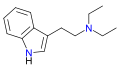 Diethyltryptamine
 -
 Diethyltryptamine
