Linguiça: Difference between revisions
CSV import |
CSV import |
||
| Line 38: | Line 38: | ||
{{Brazil-stub}} | {{Brazil-stub}} | ||
{{food-stub}} | {{food-stub}} | ||
<gallery> | |||
File:Linguicabrazil.jpg|Linguiça | |||
</gallery> | |||
Latest revision as of 01:12, 20 February 2025

Linguiça is a type of smoked cured sausage seasoned with garlic and paprika. It is a traditional dish in Portuguese cuisine and is also popular in Brazilian cuisine. Linguiça is typically made from pork, but variations can include other types of meat.
History[edit]
Linguiça has its origins in Portugal, where it has been a staple for centuries. The sausage was brought to Brazil by Portuguese colonists and has since become an integral part of Brazilian culinary traditions.
Preparation[edit]
The preparation of linguiça involves grinding the meat and mixing it with a blend of spices, including garlic and paprika. The mixture is then stuffed into natural or synthetic casings and smoked. The smoking process imparts a distinctive flavor and helps to preserve the sausage.
Culinary Uses[edit]
Linguiça can be used in a variety of dishes. It is often grilled or fried and served as a main course. It can also be used as an ingredient in stews, soups, and rice dishes. In Brazil, linguiça is a common ingredient in feijoada, a traditional black bean stew.
Regional Variations[edit]
While the basic recipe for linguiça remains consistent, there are regional variations in both Portugal and Brazil. In Portugal, different regions may use varying spice blends and smoking techniques. In Brazil, linguiça calabresa is a popular variant that includes additional spices and is often used in pizza toppings.
Related Sausages[edit]
Linguiça is similar to other types of smoked sausages, such as chorizo and andouille. However, its unique seasoning and preparation methods set it apart.
See Also[edit]
References[edit]
<references group="" responsive="1"></references>
External Links[edit]


-
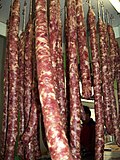 Linguiça
