Clear cell acanthoma: Difference between revisions
CSV import |
CSV import |
||
| Line 34: | Line 34: | ||
{{medicine-stub}} | {{medicine-stub}} | ||
<gallery> | |||
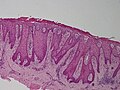
File:SkinTumors-P5280038.JPG|Clear cell acanthoma | |||
</gallery> | |||
Revision as of 21:36, 20 February 2025

Clear cell acanthoma (CCA), also known as Degos acanthoma, is a rare, benign skin tumor that typically presents as a solitary, well-circumscribed, red to brown papule or nodule. It is most commonly found on the lower extremities of middle-aged and elderly individuals. The lesion is characterized by its distinctive histopathological features, which include clear cells within the epidermis.
Clinical Presentation
Clear cell acanthoma usually appears as a small, dome-shaped lesion that can range in size from a few millimeters to several centimeters in diameter. The surface of the lesion may be smooth, verrucous, or scaly. It is often asymptomatic, but some patients may experience mild itching or tenderness.
Histopathology
Histologically, clear cell acanthoma is characterized by the presence of large, pale-staining keratinocytes within the epidermis. These clear cells are glycogen-rich, which can be demonstrated by PAS staining. The lesion typically shows acanthosis, with elongation of the rete ridges and a well-demarcated border between the lesion and the surrounding normal epidermis. There may also be a mild inflammatory infiltrate in the underlying dermis.
Diagnosis
The diagnosis of clear cell acanthoma is primarily clinical, supported by histopathological examination. Dermoscopy can aid in the diagnosis, revealing a characteristic "string of pearls" pattern of blood vessels. A skin biopsy is often performed to confirm the diagnosis and rule out other conditions such as seborrheic keratosis, squamous cell carcinoma, and psoriasis.
Treatment
Treatment is generally not necessary for clear cell acanthoma, as it is a benign lesion. However, if the lesion is symptomatic, cosmetically concerning, or there is diagnostic uncertainty, it can be removed by simple excision, cryotherapy, or laser ablation. The prognosis is excellent, with no risk of malignant transformation.
Epidemiology
Clear cell acanthoma is a rare condition, with no significant predilection for any particular race or gender. It most commonly affects individuals over the age of 40.
See Also
References
<references group="" responsive="1"></references>
External Links


-
 Clear cell acanthoma
