Manatee: Difference between revisions
CSV import |
CSV import |
||
| Line 25: | Line 25: | ||
[[Category:Mammals of North America]] | [[Category:Mammals of North America]] | ||
{{Animal-stub}} | {{Animal-stub}} | ||
== Manatee == | |||
<gallery> | |||
File:Trichechus Diversity.jpg|Trichechus Diversity | |||
File:Manatee skeleton with calf.jpg|Manatee skeleton with calf | |||
File:West Indian Manatee Skull.jpg|West Indian Manatee Skull | |||
File:Endangered Florida manatee (Trichechus manatus) (7636816484).jpg|Endangered Florida manatee | |||
File:Manatee attitudes.jpg|Manatee attitudes | |||
File:Manatee plate.jpg|Manatee plate | |||
File:mapa distribuicao Trichechus.png|Map of Trichechus distribution | |||
File:Manatee.jpg|Manatee | |||
File:Mother manatee and calf.jpg|Mother manatee and calf | |||
File:Manatee - Blue Spring State Park.JPG|Manatee at Blue Spring State Park | |||
File:Manatee bearing scars on back from boat propeller.jpg|Manatee bearing scars on back from boat propeller | |||
File:Manatee at Sea World Orlando Mar 10.JPG|Manatee at Sea World Orlando | |||
</gallery> | |||
Latest revision as of 01:08, 20 February 2025


_(7636816484).jpg)


Manatees, also known as sea cows, are large, fully aquatic, mostly herbivorous marine mammals belonging to the family Trichechidae. There are three accepted species of manatee: the Amazonian manatee (Trichechus inunguis), the West Indian manatee (Trichechus manatus), and the African manatee (Trichechus senegalensis). These slow-moving creatures are known for their gentle nature and are closely related to the dugongs, which are the only living members of the order Sirenia along with manatees.
Description[edit]
Manatees have a distinctive appearance, with a stout, gray or brown, streamlined body with a flat, paddle-shaped tail. They have two flippers and a face that is almost puckered, with whiskers on the snout. Adult manatees typically measure up to 4 meters (13 feet) long and weigh between 400 and 550 kilograms (880 to 1,210 pounds), though some individuals can grow significantly larger.
Habitat and Distribution[edit]
Manatees inhabit coastal areas and rivers where they can find their primary food source, aquatic plants. The Amazonian manatee lives in the freshwater environments of the Amazon Basin; the West Indian manatee is found in the southeastern United States, the Caribbean, and parts of Central and South America; and the African manatee inhabits the west coast and rivers of Africa.
Behavior and Diet[edit]
Manatees are herbivores, feeding on a wide variety of submerged, emergent, and floating plants. They are known to eat over 60 different freshwater and saltwater plants. To sustain their large size, a manatee can eat up to 10-15% of its body weight in vegetation daily. They are mostly solitary animals but can be found in small groups, especially during mating season. Manatees are slow movers, typically cruising at about 5 kilometers per hour (3 miles per hour).
Reproduction[edit]
Manatees have a low reproductive rate, with females giving birth to one calf every two to five years after a gestation period of about 12 months. Calves are born weighing between 20 and 30 kilograms (44 to 66 pounds) and can swim on their own shortly after birth. They remain dependent on their mothers for up to two years.
Conservation Status[edit]
Manatees are vulnerable to extinction due to several factors, including habitat destruction, boat strikes, entanglement in fishing gear, and pollution. The West Indian manatee and the African manatee are classified as Vulnerable by the International Union for Conservation of Nature (IUCN), while the Amazonian manatee is considered Endangered. Conservation efforts include habitat protection, boat speed regulations in manatee habitats, and rehabilitation programs for injured individuals.
Cultural Significance[edit]
Manatees have been part of human culture and folklore in their native regions for centuries. They are often associated with myths and legends, including being mistaken for mermaids by early sailors. Today, they are a symbol of conservation efforts in their habitats and are popular with eco-tourists.
.png)
Manatee[edit]
-
 Trichechus Diversity
 -
 Manatee skeleton with calf
 -
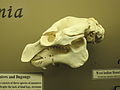 West Indian Manatee Skull
 -
 Endangered Florida manatee
 -
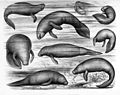 Manatee attitudes
 -
 Manatee plate
 -
 Map of Trichechus distribution
 -
 Manatee
 -
 Mother manatee and calf
 -
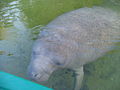 Manatee at Blue Spring State Park
 -
 Manatee bearing scars on back from boat propeller
 -
 Manatee at Sea World Orlando


