Woodpecker: Difference between revisions
CSV import Tags: mobile edit mobile web edit |
CSV import |
||
| Line 23: | Line 23: | ||
{{biology-stub}} | {{biology-stub}} | ||
<gallery> | |||
File:PileatedWoodpeckerFeedingonTree, crop.jpg|Pileated Woodpecker Feeding on Tree | |||
File:Black-rumped Flameback I IMG 7424.jpg|Black-rumped Flameback | |||
File:Dendrocopos major skull.jpg|Dendrocopos major Skull | |||
File:Ladder-back Woodpecker on Cactus.jpg|Ladder-back Woodpecker on Cactus | |||
File:Woodpecker tapping.ogg|Woodpecker Tapping | |||
File:WoodpeckerHoles.jpg|Woodpecker Holes | |||
File:BlackWoods.jpg|Black Woods | |||
File:Дятел кормит дятлёнка, Битцевский лес.jpg|Woodpecker Feeding Chick | |||
File:Lesser Goldenback.jpg|Lesser Goldenback | |||
File:Picumnus temminckii2.jpg|Picumnus temminckii | |||
File:Red-crowned woodpecker (Melanerpes rubricapillus rubricapillus) female.jpg|Red-crowned Woodpecker Female | |||
File:Cuban green woodpecker (Xiphidiopicus percussus percussus) female.JPG|Cuban Green Woodpecker Female | |||
</gallery> | |||
Latest revision as of 01:19, 20 February 2025
Woodpecker refers to any of the 180 species belonging to the family Picidae, which is part of the bird order Piciformes. Woodpeckers are known for their unique ability to peck at trees and wooden structures with their strong beaks, a behavior primarily associated with searching for insects, their larvae, or extracting sap and juices from the trees. This article provides an overview of the woodpecker, including its characteristics, habitat, and significance in various ecosystems.
Characteristics[edit]
Woodpeckers possess several distinctive physical and behavioral traits. They have strong, chisel-like beaks for drilling and drumming on trees, and long, sticky tongues for extracting food. Their zygodactyl feet, with two toes facing forward and two backward, along with stiff tail feathers, provide support and balance while climbing and pecking at vertical surfaces. Woodpeckers exhibit a wide range of sizes, from the small Downy Woodpecker to the much larger Pileated Woodpecker. Their plumage is often bright and colorful, with variations in coloration between males and females in some species.
Habitat and Distribution[edit]
Woodpeckers are found worldwide, except for Australia, New Guinea, New Zealand, Madagascar, and the extreme polar regions. They inhabit a variety of environments, including forests, deserts, jungles, and even urban areas, adapting well to different types of habitats where trees are available. The diversity of habitats reflects the adaptability of woodpeckers and their ability to find food and nesting sites in various environments.
Diet[edit]
The diet of woodpeckers primarily consists of insects and their larvae found within tree bark or wood. Some species also consume fruits, nuts, and sap. The Acorn Woodpecker, for example, is known for creating granaries by drilling holes in trees or wooden structures to store acorns. Woodpeckers play a crucial role in controlling insect populations, thus contributing to the health of their habitats.
Reproduction[edit]
Woodpeckers are cavity nesters, meaning they excavate holes in trees or wooden structures to lay their eggs and raise their young. The task of excavating typically falls to both male and female, and the cavities are also used for roosting and protection from predators. Most species are monogamous, with both parents sharing responsibilities for incubating the eggs and feeding the chicks.
Conservation[edit]
While many woodpecker species have stable populations, some are facing threats from habitat loss, deforestation, and competition for nesting sites, especially from invasive species like the European Starling. Conservation efforts are focused on preserving habitats and implementing measures to protect endangered species, such as the Ivory-billed Woodpecker, which is critically endangered and possibly extinct.
Cultural Significance[edit]
Woodpeckers have been featured in folklore and mythology in various cultures, often symbolizing hard work, determination, and the bringing of rain. They are also popular in modern culture, with characters like Woody Woodpecker bringing attention to these unique birds.

-
 Pileated Woodpecker Feeding on Tree
 -
 Black-rumped Flameback
 -
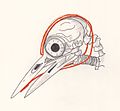 Dendrocopos major Skull
 -
Ladder-back Woodpecker on Cactus
-
 Woodpecker Tapping
 -
Woodpecker Holes
-
Black Woods
-
Woodpecker Feeding Chick
-
Lesser Goldenback
-
Picumnus temminckii
-
Red-crowned Woodpecker Female
-
Cuban Green Woodpecker Female


_female.jpg)
_female.JPG)