Flapper: Difference between revisions
CSV import |
CSV import Tags: mobile edit mobile web edit |
||
| Line 24: | Line 24: | ||
[[Category:Cultural history]] | [[Category:Cultural history]] | ||
{{culture-stub}} | {{culture-stub}} | ||
<gallery> | |||
File:Louise Brooks ggbain 32453u crop.jpg|Flapper | |||
File:FlapperOnShip1929 crop.jpg|Flapper | |||
File:Alicejoyce1926full crop.jpg|Flapper | |||
File:Clara Bow Brewster 1921.PNG|Flapper | |||
File:ThePlasticAge.png|Flapper | |||
File:Flappermag001.jpg|Flapper | |||
File:Saturday Evening Post cover 2-4-1922.jpg|Flapper | |||
</gallery> | |||
Latest revision as of 01:18, 20 February 2025
Flappers were a generation of young Western women in the 1920s who wore short skirts, bobbed their hair, listened to jazz, and flaunted their disdain for what was then considered acceptable behavior. Flappers were seen as brash for wearing excessive makeup, drinking alcohol, smoking cigarettes, driving automobiles, and treating sex in a casual manner. These behaviors were a direct challenge to the traditional roles for women of the era. The flapper movement is often associated with the Roaring Twenties, a period of prosperity and cultural shift in the wake of World War I.
Origins[edit]
The term "flapper" is believed to have originated in Britain before World War I. It was used to describe young girls who had not yet come of age. However, the term evolved in the 1920s to denote a new breed of young women who were rebellious, energetic, and bold. The end of the war brought significant changes to societies in the Western world, including the fight for women's suffrage. The passage of the Nineteenth Amendment to the United States Constitution in 1920, granting women the right to vote, was a significant victory for the women's rights movement and helped to fuel the flapper culture.
Fashion[edit]
Flapper fashion was characterized by its audacity and defiance of traditional feminine aesthetics. The iconic flapper look included short skirts that rose to just below the knee, which was scandalous by the standards of the time. The "bob" hairstyle was another hallmark of flapper fashion, as were cloche hats, which fit closely over the head. Flappers also wore rolled stockings, another departure from traditional women's fashion. Their style was complemented by the use of makeup, particularly lipstick, rouge, and eyeliner, which were previously associated with actresses and prostitutes.
Culture and Lifestyle[edit]
Flappers embodied a new lifestyle that embraced freedom and independence. They frequented jazz clubs and speakeasies, dancing to the music that defined their generation. The Charleston, a popular dance of the era, became synonymous with flappers. Their behavior, including casual dating practices and public smoking and drinking, marked a significant departure from the norms of their mothers' generation.
Impact and Legacy[edit]
The flapper movement represented a significant shift in the social and cultural dynamics of the era. It challenged the status quo and paved the way for future generations of women to assert their independence and equality. While the Great Depression and the onset of World War II led to a return to more conservative values, the legacy of the flappers continued to influence women's rights movements and fashion trends.
Criticism and Controversy[edit]
The flapper lifestyle was not without its critics. Conservatives viewed flappers as a threat to traditional values and the social order. The movement was also criticized for being exclusive to young, predominantly white, and middle or upper-class women, leaving out working-class women and women of color.
In Popular Culture[edit]
The flapper era has been romanticized in literature and film, with F. Scott Fitzgerald's "The Great Gatsby" being one of the most famous depictions. The character of Daisy Buchanan and her friend Jordan Baker embody the freedom and rebellion of the flapper lifestyle. In cinema, the flapper has been portrayed in various films set in the Roaring Twenties, further cementing its iconic status in American culture.
-
 Flapper
 -
 Flapper
 -
 Flapper
 -
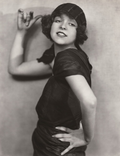 Flapper
 -
 Flapper
 -
 Flapper
 -
Flapper


_(November_1922).jpg)


_-_1.jpg)

