Amrinone: Difference between revisions
CSV import |
CSV import |
||
| Line 1: | Line 1: | ||
{{Short description|A traditional Filipino puffed rice snack}} | |||
{{Use dmy dates|date=October 2023}} | |||
'''Ampaw''' (also spelled '''ampao''') is a traditional Filipino snack made from puffed rice. It is a popular treat in the Philippines, known for its light and airy texture and sweet flavor. Ampaw is often enjoyed as a snack or dessert and is commonly found in local markets and festivals. | |||
== | ==History== | ||
Ampaw has a long history in the Philippines, with its origins tracing back to the influence of Chinese immigrants who introduced the technique of puffing rice. Over time, the recipe was adapted to local tastes, incorporating native ingredients and flavors. It became a staple snack in various regions, particularly in [[Cebu]] and [[Bulacan]]. | |||
== | ==Preparation== | ||
The | The preparation of ampaw involves several steps: | ||
# '''Rice Selection''': The process begins with selecting the right type of rice, usually glutinous rice, which is known for its sticky texture when cooked. | |||
# '''Cooking and Drying''': The rice is cooked and then dried thoroughly to remove moisture, which is crucial for the puffing process. | |||
# '''Puffing''': The dried rice is then puffed using high heat. Traditionally, this was done by frying the rice in hot sand, a method that allows the rice to expand quickly without burning. | |||
# '''Coating''': Once puffed, the rice is coated with a syrup made from sugar and sometimes honey, which acts as a binding agent and adds sweetness. | |||
# '''Molding and Cooling''': The coated rice is then molded into desired shapes and sizes, often rectangular or round, and left to cool and harden. | |||
== | ==Regional Variations== | ||
While the basic process of making ampaw is similar across the Philippines, there are regional variations: | |||
* '''Cebu''': In Cebu, ampaw is often larger and has a distinct caramel flavor. It is a popular pasalubong (souvenir) item for tourists. | |||
* '''Bulacan''': The version from Bulacan is known for its crispiness and is sometimes flavored with local ingredients such as [[pandan]] or [[coconut]]. | |||
==Cultural Significance== | |||
Ampaw is more than just a snack; it holds cultural significance in Filipino society. It is often associated with childhood memories and is a staple during local festivals and celebrations. The snack is also a symbol of Filipino ingenuity, showcasing how traditional methods can create delightful treats from simple ingredients. | |||
==Related pages== | |||
* [[Puffed rice]] | |||
* [[Filipino cuisine]] | |||
* [[Pasalubong]] | |||
==Gallery== | |||
<gallery> | |||
File:Ampao_from_Carcar,_Cebu.jpg|Ampaw from Carcar, Cebu | |||
File:5134Cuisine_foods_of_Bulacan_09.jpg|Ampaw from Bulacan | |||
</gallery> | |||
[[Category:Filipino cuisine]] | |||
[[Category:Snack foods]] | |||
Revision as of 18:31, 11 February 2025
A traditional Filipino puffed rice snack
Ampaw (also spelled ampao) is a traditional Filipino snack made from puffed rice. It is a popular treat in the Philippines, known for its light and airy texture and sweet flavor. Ampaw is often enjoyed as a snack or dessert and is commonly found in local markets and festivals.
History
Ampaw has a long history in the Philippines, with its origins tracing back to the influence of Chinese immigrants who introduced the technique of puffing rice. Over time, the recipe was adapted to local tastes, incorporating native ingredients and flavors. It became a staple snack in various regions, particularly in Cebu and Bulacan.
Preparation
The preparation of ampaw involves several steps:
- Rice Selection: The process begins with selecting the right type of rice, usually glutinous rice, which is known for its sticky texture when cooked.
- Cooking and Drying: The rice is cooked and then dried thoroughly to remove moisture, which is crucial for the puffing process.
- Puffing: The dried rice is then puffed using high heat. Traditionally, this was done by frying the rice in hot sand, a method that allows the rice to expand quickly without burning.
- Coating: Once puffed, the rice is coated with a syrup made from sugar and sometimes honey, which acts as a binding agent and adds sweetness.
- Molding and Cooling: The coated rice is then molded into desired shapes and sizes, often rectangular or round, and left to cool and harden.
Regional Variations
While the basic process of making ampaw is similar across the Philippines, there are regional variations:
- Cebu: In Cebu, ampaw is often larger and has a distinct caramel flavor. It is a popular pasalubong (souvenir) item for tourists.
- Bulacan: The version from Bulacan is known for its crispiness and is sometimes flavored with local ingredients such as pandan or coconut.
Cultural Significance
Ampaw is more than just a snack; it holds cultural significance in Filipino society. It is often associated with childhood memories and is a staple during local festivals and celebrations. The snack is also a symbol of Filipino ingenuity, showcasing how traditional methods can create delightful treats from simple ingredients.
Related pages
Gallery
-
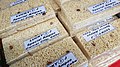 Ampaw from Carcar, Cebu
 -
 Ampaw from Bulacan


