Date Masamune: Difference between revisions
CSV import Tags: Manual revert mobile edit mobile web edit |
CSV import |
||
| Line 26: | Line 26: | ||
[[Category:People of the Edo period]] | [[Category:People of the Edo period]] | ||
{{history-stub}} | {{history-stub}} | ||
<gallery> | |||
File:Date_Masamune02.jpg|Date Masamune | |||
File:Take_ni_Suzume.svg|Take ni Suzume | |||
File:Goshichi_no_kiri_inverted.svg|Goshichi no Kiri | |||
File:Mitsubaaoi.svg|Mitsubaaoi | |||
File:Tokugawa_family_crest.svg|Tokugawa Family Crest | |||
File:Take_ni_Suzume.svg|Take ni Suzume | |||
File:Masamune_Date's_armour.jpg|Masamune Date's Armour | |||
File:Take_ni_Suzume.svg|Take ni Suzume | |||
File:Zuiho-den06s3200.jpg|Zuiho-den | |||
File:DateMasammuneToPope.jpg|Date Masamune to Pope | |||
File:Sanjuanbautista.jpg|San Juan Bautista | |||
File:Statue-of-Date-Masamune-in-Aobayama-Park-Sendai-2016.jpg|Statue of Date Masamune in Aobayama Park, Sendai | |||
</gallery> | |||
Latest revision as of 12:23, 18 February 2025
Date Masamune (伊達 政宗, September 5, 1567 – June 27, 1636) was a regional ruler of Japan's Azuchi-Momoyama period through early Edo period. He was the daimyō of the Sendai Domain in the northern part of Honshu. Known for his distinct crescent-moon-bearing helmet and missing an eye, he was dubbed Dokuganryū (独眼竜), or the "One-Eyed Dragon of Ōshu". Masamune was a notable figure in the unification of Japan under the rule of Tokugawa Ieyasu and played a key role in the establishment of the Tokugawa shogunate.
Early Life[edit]
Born in Yonezawa, Yamagata, Masamune was the eldest son of Date Terumune, the lord of the Date clan. At a young age, he contracted smallpox, which resulted in the loss of sight in his right eye. Despite this, he proved to be a formidable warrior and tactician. Following the death of his father, Masamune assumed leadership of the Date clan at the age of 17.
Military Campaigns[edit]
Masamune is known for his ambitious military campaigns to expand his territory. He was involved in numerous battles against neighboring clans and was instrumental in the Date clan's survival and expansion during Japan's tumultuous Sengoku period. His most notable campaign was his expedition to the Ōu region, where he sought to gain control over the northern provinces.
Relationship with Tokugawa Ieyasu[edit]
Masamune's relationship with Tokugawa Ieyasu, the founder of the Tokugawa shogunate, was complex. Initially, Masamune was reluctant to pledge allegiance to Ieyasu. However, after the decisive Battle of Sekigahara in 1600, which solidified Ieyasu's power, Masamune submitted to his authority. As a result, he was allowed to rule the vast Sendai Domain, which became one of the most prosperous domains under the Tokugawa shogunate.
Cultural Contributions[edit]
Masamune was not only a warrior but also a patron of the arts and culture. He encouraged the growth of Noh and Kyogen theater, tea ceremony, and the martial arts within his domain. His efforts to promote culture and education contributed significantly to the development of the Sendai region's unique cultural identity.
Legacy[edit]
Date Masamune's legacy is a complex blend of military prowess, political acumen, and cultural patronage. He is remembered as one of the most powerful and influential daimyōs of his time. His life and exploits have been romanticized in Japanese literature, film, and television, making him a legendary figure in Japanese history.
See Also[edit]

-
 Date Masamune
 -
 Take ni Suzume
 -
 Goshichi no Kiri
 -
 Mitsubaaoi
 -
 Tokugawa Family Crest
 -
Take ni Suzume
-
 Masamune Date's Armour
 -
Take ni Suzume
-
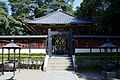 Zuiho-den
 -
 Date Masamune to Pope
 -
 San Juan Bautista
 -
 Statue of Date Masamune in Aobayama Park, Sendai


