DNA clamp: Difference between revisions
CSV import Tags: mobile edit mobile web edit |
CSV import |
||
| Line 21: | Line 21: | ||
{{biology-stub}} | {{biology-stub}} | ||
== DNA_clamp == | |||
<gallery> | |||
File:sliding_clamp_dna_complex.png|Sliding clamp DNA complex | |||
File:sliding_clamp_dna_complex_side.png|Sliding clamp DNA complex side view | |||
File:E_coli_beta_clamp_1MMI.png|E. coli beta clamp 1MMI | |||
File:1axc_tricolor.png|1AXC tricolor | |||
File:1CZD.png|1CZD | |||
</gallery> | |||
Latest revision as of 02:12, 27 February 2025


DNA clamp is a protein fold that serves as a processivity-promoting factor in DNA replication. By encircling DNA, it ensures the high-efficiency and fidelity of the replication process. DNA clamps are essential for the replication machinery's ability to synthesize long stretches of DNA without disassociating from the template strand. This article delves into the structure, function, and significance of DNA clamps in cellular replication processes.
Structure[edit]
The DNA clamp is a ring-shaped molecule that can encircle DNA. Its structure allows it to slide along the DNA without dissociating easily, acting as a sliding clamp. In bacteria, the DNA clamp is known as the β-clamp and is composed of two identical subunits that form a dimer. In eukaryotes and archaea, the clamp is referred to as the proliferating cell nuclear antigen (PCNA) and consists of three identical subunits, forming a trimer. The ring-shaped structure of these clamps is critical for their function, as it allows them to encircle the DNA strand and slide along it during replication.
Function[edit]
The primary function of the DNA clamp is to increase the processivity of DNA polymerase, the enzyme responsible for synthesizing new DNA strands. Without the clamp, DNA polymerase would frequently dissociate from the DNA template after adding a few nucleotides. The presence of the clamp ensures that DNA polymerase remains attached to the DNA, allowing for the rapid and efficient synthesis of long DNA strands. Additionally, DNA clamps play a role in coordinating various activities during replication, such as the recruitment of other proteins involved in replication, repair, and chromatin assembly.
Significance[edit]
The DNA clamp is crucial for the accuracy and efficiency of DNA replication. Its ability to increase the processivity of DNA polymerase significantly speeds up the replication process, which is essential for the rapid cell division seen in growing tissues and developing organisms. Furthermore, the clamp's role in coordinating the activities of multiple proteins during replication ensures that DNA is accurately replicated and repaired, minimizing the occurrence of mutations that could lead to genetic disorders or cancer.
Replication Process Involvement[edit]
During DNA replication, the clamp loader complex recognizes the primer-template junction and loads the DNA clamp onto the DNA. Once loaded, the clamp encircles the DNA and binds to DNA polymerase, significantly increasing its processivity. This interaction allows for the continuous synthesis of the leading strand and the efficient synthesis of the lagging strand, which is synthesized in short segments known as Okazaki fragments.
Clinical Implications[edit]
Given its essential role in DNA replication, the DNA clamp is a target for the development of antibacterial and anticancer drugs. Inhibitors that disrupt the function of the bacterial β-clamp can prevent bacterial replication, offering a potential strategy for developing new antibiotics. Similarly, targeting the eukaryotic PCNA could lead to the development of anticancer therapies that inhibit the proliferation of cancer cells.

DNA_clamp[edit]
-
 Sliding clamp DNA complex
 -
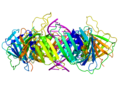 Sliding clamp DNA complex side view
 -
 E. coli beta clamp 1MMI
 -
 1AXC tricolor
 -
 1CZD
1CZD


