Factory Acts: Difference between revisions
CSV import Tags: mobile edit mobile web edit |
CSV import |
||
| Line 33: | Line 33: | ||
[[Category:19th century in the United Kingdom]] | [[Category:19th century in the United Kingdom]] | ||
{{History-stub}} | {{History-stub}} | ||
<gallery> | |||
File:Baines_1835-Mule_spinning.png|Mule spinning machine illustration from 1835 | |||
File:Toll_bridge_and_mill_across_the_River_Derwent.JPG|Toll bridge and mill across the River Derwent | |||
File:A_working_Mule_spinning_machine_at_Quarry_Bank_Mill.theora.ogv|Working mule spinning machine at Quarry Bank Mill | |||
File:Bomullsfabrik.jpg|Cotton factory | |||
File:Masson_Mills_WTM_12a_pre1867_Lancashire_Loom_5876.JPG|Lancashire loom at Masson Mills | |||
File:From_line_shaft_to_power_looms.ogv|Line shaft to power looms | |||
</gallery> | |||
Latest revision as of 11:30, 18 February 2025
Factory Acts refer to a series of labour laws enacted in the United Kingdom during the 19th century, aimed at improving the working conditions in factories. These acts were some of the earliest forms of industrial legislation. The Factory Acts were a response to the harsh conditions faced by workers, particularly children and women, during the Industrial Revolution. The legislation focused on regulating the hours of work and ensuring safer and more humane working environments.
Background[edit]
The Industrial Revolution brought significant changes to the workforce, with a shift from manual labour and artisanal workshops to large-scale factory production. This period saw a dramatic increase in the use of child labour and a surge in the number of factories. The working conditions in these factories were often deplorable, with long hours, low wages, and dangerous environments being commonplace. Public outcry and the efforts of social reformers led to the push for legislative action to protect workers.
Key Acts[edit]
Several Factory Acts were passed throughout the 19th century, each building upon the previous ones to extend protections to more workers and regulate more aspects of the work environment.
The Factory Act of 1802[edit]
The first Factory Act, also known as the Health and Morals of Apprentices Act, was passed in 1802. It was primarily concerned with the conditions of child apprentices and set basic standards for sanitation and maximum working hours.
The Factory Act of 1833[edit]
This act marked a significant step forward in labour legislation. It established a system of factory inspectors, which laid the groundwork for the enforcement of labour laws. The 1833 Act also set age limits for child labour and reduced the working hours for children and young persons.
The Factory Act of 1844[edit]
The 1844 Act introduced further regulations, including restrictions on the working hours of women and the requirement for machinery to be fenced, reducing the risk of accidents.
The Factory Act of 1847[edit]
Also known as the Ten Hours Act, this legislation limited the working day for women and young people to 10 hours, a significant reduction from previous allowances.
The Factory Act of 1874[edit]
This act further reduced the working hours for all workers and introduced stricter enforcement mechanisms for factory regulations.
Impact[edit]
The Factory Acts played a crucial role in the improvement of working conditions in the industrial sector. They not only reduced the exploitation of vulnerable workers but also set a precedent for future labour laws. The acts demonstrated the government's willingness to intervene in the private sector to protect workers' rights and welfare.
Legacy[edit]
The legacy of the Factory Acts is seen in the modern landscape of labour laws and workers' rights. They were foundational in establishing the principles of regulation, inspection, and enforcement that underpin contemporary labour legislation. The acts are a testament to the progress made from the laissez-faire attitudes of the early Industrial Revolution to a more regulated and humane approach to industrial work.

-
 Mule spinning machine illustration from 1835
 -
Toll bridge and mill across the River Derwent
-
 Working mule spinning machine at Quarry Bank Mill
 -
 Cotton factory
 -
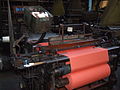 Lancashire loom at Masson Mills
 -
Line shaft to power looms


