Crown Dependencies: Difference between revisions
CSV import |
CSV import |
||
| Line 21: | Line 21: | ||
[[Category:Crown Dependencies]] | [[Category:Crown Dependencies]] | ||
{{UK-geo-stub}} | {{UK-geo-stub}} | ||
<gallery> | |||
File:British Crown Dependencies.svg|British Crown Dependencies | |||
File:Flag of Guernsey.svg|Flag of Guernsey | |||
File:Flag of Jersey.svg|Flag of Jersey | |||
File:Flag of the Isle of Man.svg|Flag of the Isle of Man | |||
File:Flag of Alderney.svg|Flag of Alderney | |||
File:Coat of Arms of Alderney.svg|Coat of Arms of Alderney | |||
File:Coat of arms of Guernsey.svg|Coat of Arms of Guernsey | |||
File:Flag of Herm.svg|Flag of Herm | |||
</gallery> | |||
Latest revision as of 17:55, 3 March 2025
Crown Dependencies refer to three island territories located in the British Isles which, although not part of the United Kingdom (UK) or the European Union (EU), are under the sovereignty of the British Crown. These are the Bailiwick of Jersey, the Bailiwick of Guernsey (which includes Guernsey itself along with other smaller islands such as Alderney, Sark, and Herm), and the Isle of Man. Each Crown Dependency has its own independent administrations, legislatures, and judicial systems, but the UK government is responsible for their defense and international representation.
History[edit]
The origins of the Crown Dependencies can be traced back to the Duchy of Normandy in the 10th and 11th centuries. When William, Duke of Normandy, became William the Conqueror and king of England in 1066, these islands were part of his dominion. Despite the loss of mainland Normandy by King John in the early 13th century, the islands remained loyal to the English crown and thus retained a unique constitutional position.
Government and Politics[edit]
Each Crown Dependency has its own system of government. The Bailiwick of Jersey and the Bailiwick of Guernsey have their own parliaments, known as the States of Jersey and the States of Guernsey, respectively. The Isle of Man has its own legislative assembly called the Tynwald, which is one of the oldest continuous parliamentary bodies in the world. While they legislate on most local matters, the UK government retains responsibility for defense and international affairs. However, the Crown Dependencies are not represented in the UK Parliament.
Economy[edit]
The economies of the Crown Dependencies are diverse, with financial services, tourism, and agriculture playing significant roles. They have developed reputations as offshore financial centers, offering banking, insurance, and investment services. This status has sometimes led to controversy regarding tax evasion and transparency. However, in recent years, there has been a push towards greater financial oversight and cooperation with international regulatory bodies.
Relationship with the UK and the EU[edit]
The relationship between the Crown Dependencies and the UK is governed by the principle of "mutual respect and understanding". The UK is responsible for the defense and international representation of the Crown Dependencies, but they are not considered part of the UK. They were not part of the EU but had limited relationships with it through the UK's membership, particularly in trade. Following the UK's departure from the EU (Brexit), the Crown Dependencies' relationship with the EU is primarily through the UK-EU Trade and Cooperation Agreement.
Cultural and Social Aspects[edit]
The Crown Dependencies have their own distinct cultural identities, with histories and traditions that reflect their unique heritage and geographical locations. The Manx language, for example, is a Gaelic language spoken in the Isle of Man, while Jèrriais and Guernésiais are spoken in Jersey and Guernsey, respectively. Each dependency also celebrates its own national day, reflecting its rich history and cultural heritage.
Conclusion[edit]
The Crown Dependencies occupy a unique position within the British Isles, balancing self-governance with the sovereignty of the British Crown. Their historical ties, governmental structures, and economic models offer fascinating insights into the complexities of modern governance and international relations.
 | This United Kingdom location article is a stub. You can help Wikipedia by adding missing information. |
-
 British Crown Dependencies
 -
 Flag of Guernsey
 -
 Flag of Jersey
 -
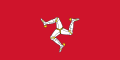 Flag of the Isle of Man
 -
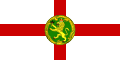 Flag of Alderney
 -
 Coat of Arms of Alderney
 -
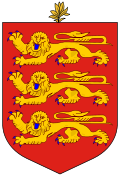 Coat of Arms of Guernsey
 -
 Flag of Herm


