Australian Capital Territory: Difference between revisions
CSV import |
CSV import |
||
| Line 30: | Line 30: | ||
{{Australia-stub}} | {{Australia-stub}} | ||
<gallery> | |||
File:Coat of Arms of the Australian Capital Territory.svg|Coat of Arms of the Australian Capital Territory | |||
File:ACT historic buildings map-MJC2.png|ACT historic buildings map | |||
File:Surveyors camp Canberra.jpg|Surveyors camp Canberra | |||
File:Naming of city of canberra capital hill 1913.jpg|Naming of city of Canberra, Capital Hill, 1913 | |||
File:ACT-Jervis Bay-Sydney-MJC.png|ACT Jervis Bay Sydney map | |||
File:Swans on molonglo river.jpg|Swans on Molonglo River | |||
File:Autumn in Canberra.jpg|Autumn in Canberra | |||
File:Canberra.jpg|Canberra | |||
File:Australian Capital Territory Legislative Assembly and the statue Ethos.jpg|Australian Capital Territory Legislative Assembly and the statue Ethos | |||
File:New Law Courts of the Australian Capital Territory.jpg|New Law Courts of the Australian Capital Territory | |||
</gallery> | |||
Latest revision as of 05:08, 3 March 2025
Australian Capital Territory (ACT) is a federal territory of Australia, located in the south-east of the country and enclaved within the state of New South Wales. It contains Canberra, the capital city of Australia, and thus serves as the seat of the Australian federal government. The ACT was established to provide a neutral location for the national capital, following a compromise between rivals Sydney and Melbourne, Australia's two largest cities.
History[edit]
The region that is now the ACT was traditionally inhabited by the Ngunnawal people, among other Indigenous Australian groups. European exploration and settlement began in the 1820s. The site was officially selected for the new nation's capital in 1908, and land was transferred from New South Wales to the federal government in 1911. The development of Canberra followed, with American architect Walter Burley Griffin winning an international competition for the city's design. The Australian Capital Territory was officially formed in 1911, and Canberra was officially named as the capital city of Australia in 1913.
Geography[edit]
The ACT is characterized by rugged mountains and hills—part of the Brindabella Range—which form its western border. The highest peak is Mount Bimberi, at 1,912 meters. The territory experiences a continental climate, with hot summers and cold winters. The Molonglo River, which has been dammed to form Lake Burley Griffin, is a central feature of Canberra and the ACT's geography.
Government and Politics[edit]
The Australian Capital Territory has its own territorial government, the Australian Capital Territory Legislative Assembly, which exercises powers delegated to it by the Australian Parliament. The Assembly is unicameral, consisting of 25 members elected from three districts. The ACT also sends representatives to the Australian Parliament, including two members to the House of Representatives and two senators.
Economy[edit]
The economy of the ACT is heavily dominated by the public sector, with federal government administration and defense being the largest employers. Education, health, and professional services are also significant contributors to the territory's economy. The presence of the Australian National University and several other higher education institutions make Canberra a center for research and innovation.
Demographics[edit]
As of the latest census, the ACT has a population of approximately 430,000 people, making it the smallest of Australia's eight states and territories by population. Canberra accounts for the vast majority of the population. The territory is known for its high level of education, with a significant proportion of residents holding tertiary qualifications.
Culture[edit]
Canberra and the ACT are home to many of Australia's most important cultural institutions, including the National Museum of Australia, the National Gallery of Australia, and the Australian War Memorial. The territory also hosts a variety of festivals and events throughout the year, such as the Canberra Balloon Spectacular and the National Folk Festival.
Education[edit]
The ACT has a strong education system, with public, Catholic, and independent schools providing primary and secondary education. The territory also hosts several tertiary institutions, including the Australian National University (ANU), the University of Canberra, and the Canberra Institute of Technology.
Transport[edit]
The ACT is well-served by roads, including the Federal Highway linking Canberra to Sydney. Public transport in Canberra is primarily provided by buses, with a light rail line also operating between the city center and the northern suburbs. Canberra Airport provides domestic and international flights.

-
 Coat of Arms of the Australian Capital Territory
 -
 ACT historic buildings map
 -
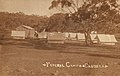 Surveyors camp Canberra
 -
 Naming of city of Canberra, Capital Hill, 1913
 -
 ACT Jervis Bay Sydney map
 -
 Swans on Molonglo River
 -
 Autumn in Canberra
 -
 Canberra
 -
 Australian Capital Territory Legislative Assembly and the statue Ethos
 -
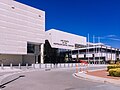 New Law Courts of the Australian Capital Territory


