Ardem Patapoutian: Difference between revisions
CSV import |
CSV import |
||
| Line 1: | Line 1: | ||
{{Short description|Surgical procedure to replace the aortic valve}} | |||
{{Use dmy dates|date=October 2023}} | |||
== | ==Aortic Valve Replacement== | ||
[[File:Diagram_of_the_human_heart_(cropped).svg|thumb|Diagram of the human heart showing the location of the aortic valve]] | |||
[[File:Gray495.png|thumb|Illustration of the heart valves, including the aortic valve]] | |||
'''Aortic valve replacement''' is a surgical procedure in which a patient's [[aortic valve]] is replaced with an artificial valve. The aortic valve is one of the four main valves in the [[heart]], and it plays a crucial role in ensuring unidirectional blood flow from the [[left ventricle]] to the [[aorta]]. | |||
==Indications== | |||
Aortic valve replacement is typically indicated for patients with severe [[aortic stenosis]] or [[aortic regurgitation]]. Aortic stenosis is a condition where the valve becomes narrowed, restricting blood flow, while aortic regurgitation occurs when the valve does not close properly, allowing blood to flow backward into the heart. | |||
== | ==Types of Replacement Valves== | ||
There are two main types of replacement valves used in aortic valve replacement: | |||
* '''Mechanical valves''': These are made from durable materials such as titanium or carbon. They are long-lasting but require patients to take lifelong [[anticoagulant]] medication to prevent blood clots. | |||
* '''Bioprosthetic valves''': These are made from animal tissue, such as pig or cow tissue, or from human tissue. They do not require long-term anticoagulation but may need to be replaced after 10-20 years. | |||
[[ | ==Surgical Techniques== | ||
[[Category: | Aortic valve replacement can be performed using different surgical techniques: | ||
[[Category: | |||
* '''Open-heart surgery''': The traditional method involves a large incision in the chest and temporarily stopping the heart to replace the valve. | |||
* '''Minimally invasive surgery''': This involves smaller incisions and may use specialized instruments and cameras to perform the surgery with less trauma to the body. | |||
* '''Transcatheter aortic valve replacement (TAVR)''': A less invasive procedure where the new valve is inserted via a catheter through the [[femoral artery]] or another access point, without the need for open-heart surgery. | |||
==Recovery and Prognosis== | |||
Recovery from aortic valve replacement varies depending on the type of surgery performed. Patients who undergo open-heart surgery may require several weeks to recover, while those who have minimally invasive procedures may recover more quickly. The prognosis after aortic valve replacement is generally good, with many patients experiencing significant improvement in symptoms and quality of life. | |||
==Complications== | |||
Potential complications of aortic valve replacement include bleeding, infection, valve dysfunction, and stroke. The risk of complications depends on the patient's overall health, the type of valve used, and the surgical technique. | |||
==Related pages== | |||
* [[Heart valve]] | |||
* [[Cardiac surgery]] | |||
* [[Aortic stenosis]] | |||
* [[Aortic regurgitation]] | |||
==Gallery== | |||
<gallery> | |||
File:Diagram_of_the_human_heart_(cropped).svg|Diagram of the human heart | |||
File:Gray495.png|Illustration of heart valves | |||
</gallery> | |||
[[Category:Cardiac surgery]] | |||
[[Category:Heart valves]] | |||
Revision as of 17:48, 11 February 2025
Surgical procedure to replace the aortic valve
Aortic Valve Replacement
.svg)

Aortic valve replacement is a surgical procedure in which a patient's aortic valve is replaced with an artificial valve. The aortic valve is one of the four main valves in the heart, and it plays a crucial role in ensuring unidirectional blood flow from the left ventricle to the aorta.
Indications
Aortic valve replacement is typically indicated for patients with severe aortic stenosis or aortic regurgitation. Aortic stenosis is a condition where the valve becomes narrowed, restricting blood flow, while aortic regurgitation occurs when the valve does not close properly, allowing blood to flow backward into the heart.
Types of Replacement Valves
There are two main types of replacement valves used in aortic valve replacement:
- Mechanical valves: These are made from durable materials such as titanium or carbon. They are long-lasting but require patients to take lifelong anticoagulant medication to prevent blood clots.
- Bioprosthetic valves: These are made from animal tissue, such as pig or cow tissue, or from human tissue. They do not require long-term anticoagulation but may need to be replaced after 10-20 years.
Surgical Techniques
Aortic valve replacement can be performed using different surgical techniques:
- Open-heart surgery: The traditional method involves a large incision in the chest and temporarily stopping the heart to replace the valve.
- Minimally invasive surgery: This involves smaller incisions and may use specialized instruments and cameras to perform the surgery with less trauma to the body.
- Transcatheter aortic valve replacement (TAVR): A less invasive procedure where the new valve is inserted via a catheter through the femoral artery or another access point, without the need for open-heart surgery.
Recovery and Prognosis
Recovery from aortic valve replacement varies depending on the type of surgery performed. Patients who undergo open-heart surgery may require several weeks to recover, while those who have minimally invasive procedures may recover more quickly. The prognosis after aortic valve replacement is generally good, with many patients experiencing significant improvement in symptoms and quality of life.
Complications
Potential complications of aortic valve replacement include bleeding, infection, valve dysfunction, and stroke. The risk of complications depends on the patient's overall health, the type of valve used, and the surgical technique.
Related pages
Gallery
-
 Diagram of the human heart
 -
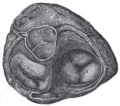 Illustration of heart valves
