Sarracenia purpurea: Difference between revisions
CSV import |
CSV import |
||
| Line 22: | Line 22: | ||
{{botany-stub}} | {{botany-stub}} | ||
== Sarracenia purpurea == | |||
<gallery> | |||
File:Sarracenia_purpurea_Flowers.JPG|Sarracenia purpurea Flowers | |||
File:Lebia_grandis.jpg|Lebia grandis | |||
File:Sarracenia_purpurea_009.jpg|Sarracenia purpurea 009 | |||
File:SarraceniaPurpureaClusius.jpg|Sarracenia Purpurea Clusius | |||
File:Sarracenia_purpurea_seeds,_by_Omar_Hoftun.jpg|Sarracenia purpurea seeds, by Omar Hoftun | |||
File:Sarracenia_purpurosa_france_2007_-_2.jpg|Sarracenia purpurosa France 2007 - 2 | |||
File:Sarracenia_purpurea_Vertical.JPG|Sarracenia purpurea Vertical | |||
File:PurplepitcherplantMN.jpg|Purple pitcher plant MN | |||
File:Sarraceniaceae_-_Sarracenia_purpurea_(8303625575).jpg|Sarraceniaceae - Sarracenia purpurea (8303625575) | |||
File:Fleur_Sarracenia_purpurea.jpeg|Fleur Sarracenia purpurea | |||
</gallery> | |||
Latest revision as of 20:54, 25 February 2025
Sarracenia purpurea, commonly known as the purple pitcher plant, is a perennial carnivorous plant in the Sarraceniaceae family. Native to the United States and Canada, it is found in nutrient-poor, acidic bogs and wetlands across the eastern seaboard, the Great Lakes region, and parts of the Canadian Maritimes. It is notable for its striking purple flowers and the distinctive pitcher-shaped leaves that trap and digest insects and other small organisms.
Description[edit]
Sarracenia purpurea produces rosettes of pitcher-shaped leaves that are primarily green with purple and red venation. The leaves are adapted to capture and digest insects using a combination of nectar, color, and scent as lures. The inner surface of the pitcher is slippery, causing prey to fall into a pool of digestive enzymes at the bottom. The plant's flowers are large, nodding, and purple, appearing in the spring. They are pollinated by bees, but the structure of the flower discourages visitation by the plant's prey.
Habitat and Distribution[edit]
This species is widely distributed in the United States and Canada, thriving in cold bogs, swamps, and other wetlands with acidic soil. It is cold-hardy and can survive freezing temperatures, making it unique among pitcher plants. Sarracenia purpurea is often found in sphagnum bogs alongside other carnivorous plants such as Drosera (sundews) and Utricularia (bladderworts).
Conservation[edit]
While Sarracenia purpurea is not currently listed as endangered, its habitat is under threat from development, pollution, and peat mining. Conservation efforts are focused on preserving its wetland habitats and ensuring the survival of this and other carnivorous plant species. In some areas, it is protected under local conservation laws.
Cultivation[edit]
Sarracenia purpurea is popular in cultivation due to its hardiness and the ornamental value of both its leaves and flowers. It requires acidic, nutrient-poor soil and consistent moisture, mimicking its natural bog habitat. It can be grown outdoors in water gardens or indoors in terrariums, provided it receives sufficient light.
In Popular Culture[edit]
The purple pitcher plant has captured the public's imagination due to its carnivorous nature and striking appearance. It has been featured in literature, art, and educational materials as an example of a plant adapted to nutrient-poor environments through carnivory.

Sarracenia purpurea[edit]
-
 Sarracenia purpurea Flowers
 -
 Lebia grandis
 -
 Sarracenia purpurea 009
 -
 Sarracenia Purpurea Clusius
 -
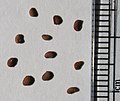 Sarracenia purpurea seeds, by Omar Hoftun
 -
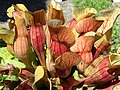 Sarracenia purpurosa France 2007 - 2
 -
 Sarracenia purpurea Vertical
 -
 Purple pitcher plant MN
 -
 Sarraceniaceae - Sarracenia purpurea (8303625575)
 -
 Fleur Sarracenia purpurea


.jpg)

