Baby hatch: Difference between revisions
CSV import Tags: mobile edit mobile web edit |
CSV import |
||
| Line 22: | Line 22: | ||
{{Social-stub}} | {{Social-stub}} | ||
<gallery> | |||
File:Babyklappe.jpg|Babyklappe | |||
File:Babybox_-_venkovní_strana.jpg|Babybox - venkovní strana | |||
File:BabyBoxPoland.JPG|BabyBox Poland | |||
File:Vondelingenluikje.JPG|Vondelingenluikje | |||
File:Ruota_Innocenti.jpg|Ruota Innocenti | |||
File:Foundling_Hospital.jpg|Foundling Hospital | |||
File:Newly_renovated_"baby_bin"_at_Door_of_Hope_in_Johannesburg,South_Africa.jpg|Newly renovated "baby bin" at Door of Hope in Johannesburg, South Africa | |||
File:Rabat_Maltese_2017_07.jpg|Rabat Maltese 2017 | |||
</gallery> | |||
Latest revision as of 00:50, 27 February 2025

Baby hatch or baby box is a location where parents can anonymously abandon their infants, in a safe and legal manner. Historically, baby hatches have been installed in various countries around the world to provide a secure alternative for the abandonment of newborns. This concept dates back to the Middle Ages, with the first recorded baby hatch believed to have been established in Italy. The primary goal of a baby hatch is to offer a safe haven for unwanted babies, preventing potential harm or death that could occur if the child were abandoned in an unsafe environment.
History[edit]
The origin of baby hatches can be traced back to the medieval period, with the establishment of the first known baby hatch in the Republic of Venice in the 12th century. These early versions were often found at monasteries or hospitals and were known as "foundling wheels." Parents could place their infant into a cylinder set into a wall, turn it around to the inside of the building, and leave anonymously. Over time, the concept spread across Europe, with many countries adopting their version of the baby hatch.
Modern Usage[edit]
In the contemporary context, baby hatches have been installed in countries across Europe, Asia, and North America. They are typically located at hospitals, social service facilities, or churches. Modern baby hatches are equipped with a bed or incubator and an alarm system to alert staff when a baby has been placed inside. The design ensures the safety and immediate care of the abandoned infant.
Legal and Ethical Considerations[edit]
The legality and ethical implications of baby hatches vary by country. Some nations have specific laws that allow for anonymous abandonment of infants in designated safe places, while others may consider the act as illegal abandonment. Ethical debates surrounding baby hatches focus on the rights of the child to know their parentage, the rights of parents to anonymity, and the potential for baby hatches to encourage abandonment.
Impact[edit]
The impact of baby hatches on society is multifaceted. Advocates argue that they save lives by providing a safe option for desperate parents and thereby preventing potential infanticide or neglect. Critics, however, contend that baby hatches may encourage parents to give up their children without exploring other options or receiving necessary support. Research on the effectiveness and social implications of baby hatches is ongoing, with studies examining their role in child welfare systems and their impact on rates of infant abandonment.
See Also[edit]
This social science related article is a stub. You can help WikiMD by expanding it.
-
 Babyklappe
 -
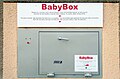 Babybox - venkovní strana
 -
 BabyBox Poland
 -
 Vondelingenluikje
 -
 Ruota Innocenti
 -
 Foundling Hospital
 -
 Newly renovated "baby bin" at Door of Hope in Johannesburg, South Africa
 -
 Rabat Maltese 2017


