Ouzo effect: Difference between revisions
CSV import |
CSV import |
||
| Line 21: | Line 21: | ||
[[Category:Greek cuisine]] | [[Category:Greek cuisine]] | ||
{{food-stub}} | {{food-stub}} | ||
== Ouzo_effect == | |||
<gallery> | |||
File:Preparing_absinthe.jpg|Preparing absinthe | |||
File:Glassofarak_en.jpg|Glass of arak | |||
</gallery> | |||
Latest revision as of 02:13, 27 February 2025
Ouzo effect refers to a fascinating phenomenon observed when water is added to ouzo, a popular Greek anise-flavored liqueur. This effect, also known as the louche effect, results in the transformation of the clear liquid into a milky-white emulsion. The ouzo effect is not exclusive to ouzo but can also be observed in other anise-flavored spirits such as pastis, absinthe, and arak. This phenomenon is a classic example of an oil-in-water emulsion and is of interest not only to those in the food and beverage industry but also to chemists and physicists studying the principles of emulsification and colloidal systems.
Mechanism[edit]
The ouzo effect occurs due to the presence of anethole, the primary component of the essential oil of anise, which is soluble in alcohol but not in water. When water is added to ouzo, the solubility of anethole decreases significantly, leading to its precipitation out of the solution. This precipitation causes the formation of tiny droplets of anethole dispersed throughout the water, creating a stable emulsion that scatters light and gives the liquid its characteristic milky appearance.
Factors Influencing the Ouzo Effect[edit]
Several factors influence the ouzo effect, including the concentration of anethole, the alcohol content of the liqueur, and the temperature of the mixture. The ratio of water to ouzo also plays a critical role; adding water slowly and in small amounts tends to produce a more pronounced effect. Additionally, the presence of other solutes, such as sugars or salts, can affect the stability and appearance of the emulsion.
Applications and Significance[edit]
Beyond its relevance to the beverage industry, the ouzo effect has implications in various scientific and industrial fields. It serves as a model system for studying emulsions and nanoemulsions in food science, pharmacology, and cosmetics. Understanding the principles behind the ouzo effect can aid in the design of emulsions with desired properties, such as stability and droplet size, which are crucial for the formulation of creams, lotions, and drug delivery systems.
See Also[edit]

Ouzo_effect[edit]
-
 Preparing absinthe
 -
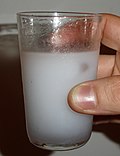 Glass of arak


