Chinampa: Difference between revisions
CSV import Tags: mobile edit mobile web edit |
CSV import Tags: mobile edit mobile web edit |
||
| Line 24: | Line 24: | ||
{{Agriculture-stub}} | {{Agriculture-stub}} | ||
<gallery> | |||
File:camas_chinampas.jpg|Chinampa | |||
File:Lake_Texcoco_c_1519.png|Lake Texcoco circa 1519 | |||
File:The_Digital_Edition_of_the_Florentine_Codex_Book_1_0640_Seeding,_tilling_and_harvesting_maize.tif|Seeding, tilling, and harvesting maize | |||
File:Chinampas.jpg|Chinampa | |||
File:Trajinera_en_canal_Nativitas.jpg|Trajinera en canal Nativitas | |||
File:Sembradío_en_chinampa.JPG|Sembradío en chinampa | |||
File:Chinampa.JPG|Chinampa | |||
File:Gran_Ganado_Chinampas_Xochimilco.JPG|Gran Ganado Chinampas Xochimilco | |||
</gallery> | |||
Latest revision as of 11:36, 18 February 2025
Chinampa is a traditional Mesoamerican method of agriculture that involves the construction of small, rectangular areas of fertile arable land to grow crops on the shallow lake beds in the Valley of Mexico. Originating with the pre-Columbian civilizations such as the Aztecs, chinampas are often referred to as "floating gardens" due to their appearance, although they are not truly floating. They were an ingenious adaptation to the swampy conditions of the region, allowing for year-round agriculture and the efficient use of land and water resources.
History[edit]
The history of chinampas dates back to the early post-classic period of Mesoamerica, around the 12th century CE, primarily associated with the Aztec civilization and other peoples in the Valley of Mexico. The Aztecs, upon settling in the area, faced the challenge of a lack of arable land and responded by creating chinampas in the shallow lakes around their capital, Tenochtitlan. This agricultural technique allowed them to maximize agricultural production and support a large population.
Construction[edit]
Chinampas were constructed by staking out an area in a shallow lake and weaving a fence of reeds to enclose it. The enclosed area was then filled with mud, lake sediment, and decaying vegetation, which provided a rich growing medium. Willow trees were often planted at the corners of the chinampa to secure the structure with their roots. These artificial islands varied in size but were typically about 30 meters long and 2.5 meters wide.
Agriculture[edit]
The chinampa system allowed for an extremely productive form of agriculture, with the possibility of harvesting up to seven crops a year. The main crops grown on chinampas included maize, beans, squash, amaranth, tomatoes, chili peppers, and flowers. The surrounding water provided a microclimate that reduced the risk of frost and maintained a high humidity level. Additionally, the waterways facilitated transportation and the distribution of crops.
Cultural Significance[edit]
Chinampas were more than just an agricultural innovation; they were a fundamental part of Aztec culture and economy, enabling the growth of their empire. The productivity of chinampa agriculture supported the dense populations of Aztec cities and was a key factor in the success of their civilization.
Modern Use[edit]
Today, chinampas are still used in some areas of Mexico, particularly in the Xochimilco and Chalco regions near Mexico City. These modern-day chinampas continue to be a source of vegetables and flowers for the city, although they face threats from urbanization, pollution, and neglect. Efforts are being made to preserve and revive this ancient agricultural technique due to its sustainability and efficiency.
Environmental Impact[edit]
Chinampas are considered a sustainable form of agriculture that enhances biodiversity, improves water quality, and reduces the need for artificial fertilizers and pesticides. Their revival in contemporary agriculture is seen as a way to address food security, urban sprawl, and environmental degradation.

This article is a agriculture stub. You can help WikiMD by expanding it!
-
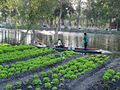 Chinampa
 -
 Lake Texcoco circa 1519
 -
 Seeding, tilling, and harvesting maize
 -
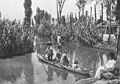 Chinampa
 -
 Trajinera en canal Nativitas
 -
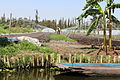 Sembradío en chinampa
 -
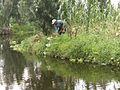 Chinampa
 -
 Gran Ganado Chinampas Xochimilco


