Cutthroat trout: Difference between revisions
CSV import |
CSV import |
||
| Line 23: | Line 23: | ||
[[Category:Freshwater fish of North America]] | [[Category:Freshwater fish of North America]] | ||
{{ichthyology-stub}} | {{ichthyology-stub}} | ||
== Cutthroat trout gallery == | |||
<gallery> | |||
File:Trout cutthroat fish oncorhynchus clarkii clarkii.jpg|Trout cutthroat fish oncorhynchus clarkii clarkii | |||
File:Cutthroat Trout Lineage.tif|Cutthroat Trout Lineage | |||
File:Oncorhynchus clarkii.jpg|Oncorhynchus clarkii | |||
File:Westslope Cutthroat Trout Middle Fork Flathead (27912294517) (cropped).jpg|Westslope Cutthroat Trout Middle Fork Flathead | |||
File:Coeur d’ Alene cutthroat trout.jpg|Coeur d’Alene cutthroat trout | |||
File:St. Joe cutthroat trout.jpg|St. Joe cutthroat trout | |||
File:North Fork Clearwater cutthroat trout.jpg|North Fork Clearwater cutthroat trout | |||
File:Clearwater Headwaters cutthroat trout.jpg|Clearwater Headwaters cutthroat trout | |||
File:Clearwater-Eastern Cascade cutthroat trout.jpg|Clearwater-Eastern Cascade cutthroat trout | |||
File:Salmon River cutthroat trout.jpg|Salmon River cutthroat trout | |||
</gallery> | |||
Latest revision as of 05:06, 3 March 2025

Cutthroat Trout (Oncorhynchus clarkii) is a species of salmonid native to cold-water tributaries of the Pacific Ocean, Rocky Mountains, and Great Basin in North America. Named for the distinctive red coloration on the underside of its jaw, the cutthroat trout is an important species both ecologically and as a game fish. This species exhibits a wide range of life history strategies and can be found in an array of habitats, making it a fascinating subject of study for ichthyologists and a prized target for anglers.
Description[edit]
Cutthroat trout vary widely in size, coloration, and habitat preferences, largely due to their diverse subspecies. Generally, they have elongated bodies with broad, rounded heads. Their coloration can range from yellow-green to gray, with a distinctive red or orange cutthroat mark beneath their jaws. They can reach up to 18 inches in length, though size varies significantly across different environments and subspecies.
Habitat and Distribution[edit]
The cutthroat trout occupies a variety of freshwater habitats, including streams, rivers, and lakes. Its range extends from the coastal streams of Alaska down through British Columbia, throughout the Rocky Mountains to New Mexico, and into the Great Basin region. The species' adaptability to different environmental conditions has resulted in the evolution of several subspecies, each with unique characteristics suited to their specific habitats.
Subspecies[edit]
There are several recognized subspecies of cutthroat trout, including the Coastal Cutthroat Trout (Oncorhynchus clarkii clarkii), the Westslope Cutthroat Trout (Oncorhynchus clarkii lewisi), and the Yellowstone Cutthroat Trout (Oncorhynchus clarkii bouvieri), among others. Each subspecies is adapted to its unique environment, with variations in size, coloration, and spawning behaviors.
Conservation[edit]
The cutthroat trout faces numerous threats, including habitat loss, pollution, and competition from non-native species such as the rainbow trout (Oncorhynchus mykiss). Conservation efforts are underway to protect and restore cutthroat trout populations, including habitat restoration, the establishment of catch-and-release fishing regulations, and the removal of invasive species. Despite these efforts, several subspecies are considered to be at risk and are listed under various conservation statuses.
Fishing[edit]
Cutthroat trout are a popular target for sport fishing, appreciated for their fighting spirit and the challenge they present to anglers. They can be caught using a variety of techniques, including fly fishing, spinning, and bait fishing. The species is also an important cultural icon in the regions it inhabits, celebrated in festivals, art, and literature.
Culinary Uses[edit]
While cutthroat trout are primarily sought after for sport, they are also valued for their culinary qualities. Their flesh is flavorful and can be prepared in various ways, including grilling, smoking, and baking. However, due to conservation concerns, many jurisdictions have implemented regulations to limit the harvest of cutthroat trout.
This ichthyology related article is a stub. You can help WikiMD by expanding it.
Cutthroat trout gallery[edit]
-
 Trout cutthroat fish oncorhynchus clarkii clarkii
 -
 Cutthroat Trout Lineage
 -
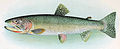 Oncorhynchus clarkii
 -
 Westslope Cutthroat Trout Middle Fork Flathead
 -
 Coeur d’Alene cutthroat trout
 -
 St. Joe cutthroat trout
 -
 North Fork Clearwater cutthroat trout
 -
 Clearwater Headwaters cutthroat trout
 -
 Clearwater-Eastern Cascade cutthroat trout
 -
 Salmon River cutthroat trout


_(cropped).jpg)


