Paul Nobuo Tatsuguchi: Difference between revisions
CSV import |
CSV import Tags: mobile edit mobile web edit |
||
| Line 24: | Line 24: | ||
[[Category:People from Hiroshima]] | [[Category:People from Hiroshima]] | ||
{{military-stub}} | {{military-stub}} | ||
== Paul_Nobuo_Tatsuguchi == | |||
<gallery> | |||
File:TatsuguchiArmy.jpg|Paul Nobuo Tatsuguchi in Army uniform | |||
File:NobuoandTaekoTatsuguchi.jpg|Paul Nobuo Tatsuguchi with Taeko Tatsuguchi | |||
File:AttuJapaneseTroops.jpg|Japanese troops on Attu | |||
File:Attu_Invasion_02.jpg|Invasion of Attu | |||
File:AttuBanzai.jpg|Banzai charge on Attu | |||
File:Attu_peace_monument.jpg|Peace monument on Attu | |||
</gallery> | |||
Latest revision as of 04:46, 18 February 2025
Paul Nobuo Tatsuguchi, sometimes also known as Nobuo Tatsuguchi, was a Japanese surgeon and Seventh-day Adventist missionary. He is most notably remembered for his diary, which was written during the Battle of Attu in the Aleutian Islands during World War II. Tatsuguchi's writings provide a unique perspective on the war, blending his Christian faith with his duties as a Japanese military surgeon.
Early Life[edit]
Paul Nobuo Tatsuguchi was born on September 31, 1911, in Hiroshima, Japan. He pursued his medical education at the Loma Linda University in California, United States, where he became a Seventh-day Adventist. After completing his studies, Tatsuguchi returned to Japan and married Taeko Miyazaki. Despite his American education and Christian faith, Tatsuguchi was drafted into the Imperial Japanese Army as a medic due to the outbreak of World War II.
World War II and the Battle of Attu[edit]
In 1943, Tatsuguchi was stationed on Attu Island, part of the Aleutian Islands, which had been occupied by Japanese forces. During the Battle of Attu, which took place from May 11 to May 30, 1943, Tatsuguchi kept a detailed diary. His entries recorded not only the medical challenges he faced, including performing surgeries under primitive conditions, but also his personal reflections and prayers. Tatsuguchi's diary vividly described the harsh realities of war, the suffering of the soldiers, and his struggle to reconcile his pacifist beliefs with his duties as a military surgeon.
The Diary[edit]
After Tatsuguchi's death in the battle, his diary was found by American forces. The diary was translated and circulated among U.S. troops and later published, offering insights into the human aspects of war from the perspective of an enemy soldier. Tatsuguchi's account challenged the prevailing perceptions among American soldiers about their Japanese adversaries, highlighting shared humanity amidst the brutality of war.
Legacy[edit]
Paul Nobuo Tatsuguchi's life and diary have left a lasting impact. His story is a poignant reminder of the complexities of identity, loyalty, and faith in times of war. It also serves as a testament to the universal experiences of suffering, hope, and the search for meaning amidst conflict. Tatsuguchi is remembered both in Japan and the United States, with his diary being studied as an important historical document that provides a deeply personal view of World War II.
See Also[edit]

Paul_Nobuo_Tatsuguchi[edit]
-
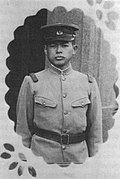 Paul Nobuo Tatsuguchi in Army uniform
 -
 Paul Nobuo Tatsuguchi with Taeko Tatsuguchi
 -
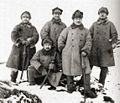 Japanese troops on Attu
 -
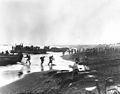 Invasion of Attu
 -
 Banzai charge on Attu
 -
 Peace monument on Attu


