Jan Baptist van Helmont: Difference between revisions
CSV import |
CSV import |
||
| Line 30: | Line 30: | ||
[[Category:People in the history of medicine]] | [[Category:People in the history of medicine]] | ||
{{scientist-stub}} | {{scientist-stub}} | ||
== Jan_Baptist_van_Helmont == | |||
<gallery> | |||
File:Jan_Baptist_van_Helmont_portrait.jpg|Portrait of Jan Baptist van Helmont | |||
File:Jan_Baptist_van_Helmont_and_his_son.jpg|Jan Baptist van Helmont and his son | |||
File:Title_page_of_Ortus_medicinae_(cropped).jpg|Title page of Ortus medicinae | |||
File:Portrait_of_J.B._van_Helmont,_Aufgang...1683_Wellcome_L0003194.jpg|Portrait of J.B. van Helmont | |||
File:1963_NEDER_OVER_HEEMBEEK_LA_TOUR_ROMANE_dessin_par_Léon_van_Dievoet_1963.JPG|Jan Baptist van Helmont | |||
File:JB_van_Helmont_statue,_Brussels.JPG|Statue of Jan Baptist van Helmont, Brussels | |||
</gallery> | |||
Latest revision as of 11:30, 18 February 2025

Jan Baptist van Helmont (1580 – 1644) was a Flemish chemist, physiologist, and physician. He is often considered one of the founders of chemistry alongside Robert Boyle and Paracelsus. Van Helmont is most noted for his early ideas on spontaneous generation, the development of the concept of gases, and for his experiments on the growth of plants.
Early Life and Education[edit]
Jan Baptist van Helmont was born in Brussels, which was then part of the Spanish Netherlands, into a wealthy family. He initially studied at the Catholic University of Leuven, where he was inclined towards the study of mysticism, medicine, and chemistry. After obtaining his degree in medicine, van Helmont traveled across Europe, learning from various scholars and furthering his interest in chemical and medical sciences.
Contributions to Science[edit]
Van Helmont's work was revolutionary in several aspects of natural science. His contributions can be broadly categorized into chemistry, physiology, and medicine.
Chemistry[edit]
Van Helmont introduced the idea that substances can change form, laying the groundwork for the concept of chemical reactions. He is credited with the introduction of the word "gas" into the scientific vocabulary, derived from the Greek word "chaos". His most famous experiment involved a willow tree, which he grew for five years in a pot containing 200 pounds of soil. The tree gained about 164 pounds, while the soil lost only a negligible amount of weight. From this, he concluded that the growth of the tree came from water, not soil, which was a significant step towards understanding photosynthesis and plant nutrition.
Physiology and Medicine[edit]
In the field of medicine, van Helmont was ahead of his time in understanding the importance of chemicals and gases in the body's physiology. He conducted experiments that led him to distinguish between different types of gases, such as carbon dioxide, which he referred to as "gas sylvestre". His work in this area laid the foundation for later studies in respiration and metabolism.
Philosophical Beliefs[edit]
Van Helmont was deeply influenced by Paracelsus and believed in the idea that nature was a living, interconnected whole. He was critical of the prevailing Aristotelian and Galenic doctrines, advocating instead for a more empirical approach to science and medicine. His philosophical beliefs also extended to the mystical, with interests in alchemy and the idea of spontaneous generation.
Legacy[edit]
Jan Baptist van Helmont's work significantly influenced the development of chemistry and physiology. His empirical methods and rejection of ancient doctrines paved the way for future scientists to explore and understand the natural world through observation and experiment. Despite some of his ideas being later disproven, his innovative approach to science and his contributions to the understanding of gases and plant growth remain his lasting legacy.
See Also[edit]

Jan_Baptist_van_Helmont[edit]
-
 Portrait of Jan Baptist van Helmont
 -
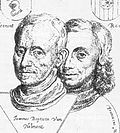 Jan Baptist van Helmont and his son
 -
 Title page of Ortus medicinae
 -
 Portrait of J.B. van Helmont
 -
 Jan Baptist van Helmont
 -
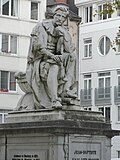 Statue of Jan Baptist van Helmont, Brussels


.jpg)


