University of Birmingham: Difference between revisions
CSV import |
CSV import |
||
| Line 1: | Line 1: | ||
{{short description|Public research university in Birmingham, England}} | |||
{{Use dmy dates|date=October 2023}} | |||
{{Use British English|date=October 2023}} | |||
The '''University of Birmingham | The '''University of Birmingham''' is a public research university located in [[Birmingham]], [[England]]. It received its royal charter in 1900 as a successor to [[Mason Science College]] and [[Queen's College, Birmingham]]. The university is a founding member of both the [[Russell Group]] of British research universities and the international network of research universities, [[Universitas 21]]. | ||
==History== | ==History== | ||
The University of Birmingham | The University of Birmingham was established by [[Joseph Chamberlain]], a prominent politician and former mayor of Birmingham. The university was formed by the merger of Mason Science College and Queen's College, Birmingham. It was the first civic or 'red brick' university to receive a royal charter. | ||
== | ===Early years=== | ||
The | The university's origins can be traced back to the establishment of the Birmingham Medical School in 1825 and Mason Science College in 1875. The university was granted its royal charter in 1900, making it the first civic university in England to receive such a charter. | ||
== | ===Development and expansion=== | ||
Throughout the 20th century, the university expanded its campus and academic offerings. Notable developments include the construction of the [[Aston Webb Building]], which houses the university's Great Hall, and the establishment of the [[Barber Institute of Fine Arts]]. | |||
== | ==Campus== | ||
The main campus of the University of Birmingham is located in the Edgbaston area of Birmingham. The campus is known for its red-brick buildings and expansive green spaces. | |||
== | ===Notable buildings=== | ||
* The [[Aston Webb Building]] is one of the university's most iconic structures, featuring a grand entrance and housing the Great Hall. | |||
* [[Old Joe]], the university's clock tower, is a prominent landmark and one of the tallest freestanding clock towers in the world. | |||
* The [[Barber Institute of Fine Arts]] is renowned for its art collection and concert hall. | |||
== | ==Academics== | ||
The | The University of Birmingham offers a wide range of undergraduate and postgraduate programs across various disciplines. It is organized into several colleges, including the College of Arts and Law, the College of Engineering and Physical Sciences, and the College of Medical and Dental Sciences. | ||
== | ===Research=== | ||
The | The university is known for its research output and has been involved in numerous groundbreaking projects. It is home to several research institutes and centers, including the [[Birmingham Energy Institute]] and the [[Institute of Cancer and Genomic Sciences]]. | ||
[[ | ==Notable alumni== | ||
[[Category:University of Birmingham]] | The University of Birmingham has produced many notable alumni, including: | ||
* [[Neville Chamberlain]], former Prime Minister of the United Kingdom. | |||
* [[Stanley Baldwin]], former Prime Minister of the United Kingdom. | |||
* [[Paul Nurse]], Nobel Prize-winning biologist. | |||
* [[Valerie Amos]], former United Nations Under-Secretary-General for Humanitarian Affairs. | |||
==Related pages== | |||
* [[Russell Group]] | |||
* [[Universitas 21]] | |||
* [[Joseph Chamberlain]] | |||
==References== | |||
{{reflist}} | |||
==Gallery== | |||
<gallery> | |||
File:University_of_Birmingham_Crest_Logo_RGB_POS_Landscape.png|University of Birmingham Crest | |||
File:bbuilding.jpg|Aston Webb Building | |||
File:Hallaston.jpg|Aston Webb Hall | |||
File:BirminghamBarberInstitute.jpg|Barber Institute of Fine Arts | |||
File:Barber_Institute_Interior.jpg|Interior of the Barber Institute | |||
File:Aston_Webb_Building_Entrance_Statues_University_of_Birmingham.JPG|Entrance statues of the Aston Webb Building | |||
File:Poynting_Physics_building_2.jpg|Poynting Physics Building | |||
File:The_new_school_of_Engineering_Building,_University_of_Birmingham.jpg|School of Engineering Building | |||
File:Plan_Edgbaston_University_1909.jpg|1909 Plan of Edgbaston University | |||
File:BirminghamUniversityChancellorsCourt.jpg|Chancellor's Court | |||
File:Old_Joe_Big.jpg|Old Joe Clock Tower | |||
File:Learning_Center.jpg|Learning Center | |||
File:University_of_Birmingham_-_geograph.org.uk_-_464655.jpg|University of Birmingham | |||
File:Muirhead_Tower_at_University_of_Birmingham.jpg|Muirhead Tower | |||
File:University_station_-_geograph.org.uk_-_1342434.jpg|University Station | |||
File:Lapworth_Museum.jpg|Lapworth Museum | |||
File:Mason_Science_College.png|Mason Science College | |||
File:Aston_webb1.JPG|Aston Webb Building | |||
File:Masoncroft.jpg|Mason Croft | |||
File:UoBirmingham_Observatory.jpg|University Observatory | |||
File:Bloye_BUGS_mermaid,_stone.jpg|Bloye BUGS Mermaid | |||
File:Bham-library.jpg|University Library | |||
File:University_of_Birmingham._Main_Library_(33445558518).jpg|Main Library | |||
File:BirminghamQueenElizabethHospitalMedicalSchool.jpg|Queen Elizabeth Hospital Medical School | |||
File:Birmingham_10_Years.png|Birmingham 10 Years | |||
File:Birmingham_Business_School.jpg|Birmingham Business School | |||
File:BirminghamBUGS.jpg|Birmingham BUGS | |||
File:Green_Playing_Fields_and_Red_Brick_-_geograph.org.uk_-_560877.jpg|Green Playing Fields | |||
File:Aston_Webb_from_UOB_Clock_Tower.JPG|View from Old Joe | |||
File:Mason_Hall,_University_of_Birmingham_-_geograph.org.uk_-_2746379.jpg|Mason Hall | |||
File:Shackleton_Hall,_University_of_Birmingham_-_geograph.org.uk_-_2829367.jpg|Shackleton Hall | |||
File:Bloye_BUGS_mermaid,_bronze.jpg|Bloye BUGS Mermaid Bronze | |||
File:Norman_Haworth.jpg|Norman Haworth | |||
File:Peter_Brian_Medawar.jpg|Peter Brian Medawar | |||
File:Neville_Chamberlain_by_William_Orpen_-_1929.jpg|Neville Chamberlain | |||
File:Stanley_Baldwin_ggbain.35233.jpg|Stanley Baldwin | |||
File:Perry_Christie_2013_(cropped).jpg|Perry Christie | |||
File:1_geoffrey_ma_cj_hk_2017_smu.jpg|Geoffrey Ma | |||
File:Paul_Nurse_2007.jpg|Paul Nurse | |||
File:Valerie_Amos_DFID_2013.jpg|Valerie Amos | |||
File:Mexico.RodolfoNeriVela.01.jpg|Rodolfo Neri Vela | |||
File:GeneralSirMikeJackson_cropped.jpg|General Sir Mike Jackson | |||
</gallery> | |||
[[Category:University of Birmingham| ]] | |||
Revision as of 01:13, 10 February 2025
The University of Birmingham is a public research university located in Birmingham, England. It received its royal charter in 1900 as a successor to Mason Science College and Queen's College, Birmingham. The university is a founding member of both the Russell Group of British research universities and the international network of research universities, Universitas 21.
History
The University of Birmingham was established by Joseph Chamberlain, a prominent politician and former mayor of Birmingham. The university was formed by the merger of Mason Science College and Queen's College, Birmingham. It was the first civic or 'red brick' university to receive a royal charter.
Early years
The university's origins can be traced back to the establishment of the Birmingham Medical School in 1825 and Mason Science College in 1875. The university was granted its royal charter in 1900, making it the first civic university in England to receive such a charter.
Development and expansion
Throughout the 20th century, the university expanded its campus and academic offerings. Notable developments include the construction of the Aston Webb Building, which houses the university's Great Hall, and the establishment of the Barber Institute of Fine Arts.
Campus
The main campus of the University of Birmingham is located in the Edgbaston area of Birmingham. The campus is known for its red-brick buildings and expansive green spaces.
Notable buildings
- The Aston Webb Building is one of the university's most iconic structures, featuring a grand entrance and housing the Great Hall.
- Old Joe, the university's clock tower, is a prominent landmark and one of the tallest freestanding clock towers in the world.
- The Barber Institute of Fine Arts is renowned for its art collection and concert hall.
Academics
The University of Birmingham offers a wide range of undergraduate and postgraduate programs across various disciplines. It is organized into several colleges, including the College of Arts and Law, the College of Engineering and Physical Sciences, and the College of Medical and Dental Sciences.
Research
The university is known for its research output and has been involved in numerous groundbreaking projects. It is home to several research institutes and centers, including the Birmingham Energy Institute and the Institute of Cancer and Genomic Sciences.
Notable alumni
The University of Birmingham has produced many notable alumni, including:
- Neville Chamberlain, former Prime Minister of the United Kingdom.
- Stanley Baldwin, former Prime Minister of the United Kingdom.
- Paul Nurse, Nobel Prize-winning biologist.
- Valerie Amos, former United Nations Under-Secretary-General for Humanitarian Affairs.
Related pages
References
Gallery
-
University of Birmingham Crest
-
 Aston Webb Building
 -
Aston Webb Hall
-
 Barber Institute of Fine Arts
 -
 Interior of the Barber Institute
 -
 Entrance statues of the Aston Webb Building
 -
 Poynting Physics Building
 -
 School of Engineering Building
 -
 1909 Plan of Edgbaston University
 -
 Chancellor's Court
 -
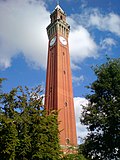 Old Joe Clock Tower
 -
Learning Center
-
 University of Birmingham
 -
 Muirhead Tower
 -
 University Station
 -
 Lapworth Museum
 -
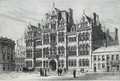 Mason Science College
 -
 Aston Webb Building
 -
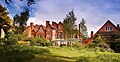 Mason Croft
 -
 University Observatory
 -
 Bloye BUGS Mermaid
 -
 University Library
 -
 Main Library
 -
 Queen Elizabeth Hospital Medical School
 -
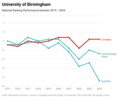 Birmingham 10 Years
 -
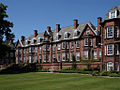 Birmingham Business School
 -
 Birmingham BUGS
 -
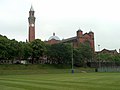 Green Playing Fields
 -
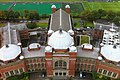 View from Old Joe
 -
 Mason Hall
 -
 Shackleton Hall
 -
 Bloye BUGS Mermaid Bronze
 -
 Norman Haworth
 -
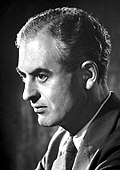 Peter Brian Medawar
 -
 Neville Chamberlain
 -
 Stanley Baldwin
 -
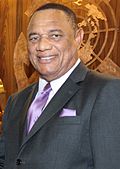 Perry Christie
 -
 Geoffrey Ma
 -
 Paul Nurse
 -
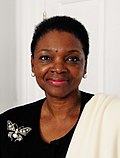 Valerie Amos
 -
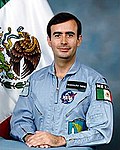 Rodolfo Neri Vela
 -
 General Sir Mike Jackson


.jpg)


.jpg)


