Instruments used in medical laboratories: Difference between revisions
CSV import |
CSV import |
||
| Line 47: | Line 47: | ||
{{Incomplete list}} | {{Incomplete list}} | ||
<gallery> | |||
File:Test_tubes.jpg|Test tubes used in medical laboratories | |||
File:Beakers.jpg|Beakers used in medical laboratories | |||
File:Burette.svg|Burette used in medical laboratories | |||
File:Cuvette_with_penny.jpg|Cuvette with penny used in medical laboratories | |||
File:Szalka_petriego.jpg|Petri dish used in medical laboratories | |||
File:Pipetas_gilson.JPG|Pipettes used in medical laboratories | |||
File:20070422_dispensible_pipett.jpg|Dispensible pipette used in medical laboratories | |||
File:Pasteur_Pipets.jpg|Pasteur pipets used in medical laboratories | |||
File:Erlenmeyer_Flasks.jpg|Erlenmeyer flasks used in medical laboratories | |||
File:Spectrophoto-controls.svg|Spectrophotometer controls used in medical laboratories | |||
File:Microtiter_plate.JPG|Microtiter plate used in medical laboratories | |||
File:Old_light_microscope.jpg|Old light microscope used in medical laboratories | |||
</gallery> | |||
Revision as of 11:51, 18 February 2025
Instruments Used in Medical Laboratories
Medical laboratories are critical facilities where various tests are conducted on clinical specimens to obtain information about the health of a patient as it pertains to the diagnosis, treatment, and prevention of disease. These laboratories utilize a wide array of instruments and equipment, each serving a unique purpose in the diagnostic process. This article provides an overview of some of the most commonly used instruments in medical laboratories.
Microscopes
A Microscope is one of the most fundamental instruments in a medical laboratory. It is used to magnify objects that are too small to be seen with the naked eye, such as cells, bacteria, and viruses. There are several types of microscopes, but the most commonly used in medical laboratories are the compound light microscopes and electron microscopes.
Centrifuges
Centrifuges are devices that apply centrifugal force to separate particles from a solution according to their size, shape, density, viscosity of the medium, and rotor speed. In medical laboratories, centrifuges are used for separating plasma or serum from blood samples, among other applications.
Autoclaves
Autoclaves are used to sterilize equipment and supplies by subjecting them to high-pressure saturated steam at 121 °C for around 15–20 minutes depending on the size of the load and the contents. They are essential in laboratories to prevent contamination and to ensure the safety of laboratory personnel.
Spectrophotometers
Spectrophotometers measure the amount of light that a chemical substance absorbs. They are widely used in medical laboratories for various tests, including enzyme-linked immunosorbent assays (ELISA), to determine the concentration of a substance in a sample.
Pipettes
Pipettes are used in laboratories to transport a measured volume of liquid. Accuracy and precision in liquid handling are crucial in medical laboratory operations, making pipettes indispensable tools for tasks ranging from simple liquid transfer to more complex sample preparation procedures.
Incubators
Incubators are used to grow and maintain microbiological cultures or cell cultures. They regulate temperature, humidity, and sometimes CO2 and oxygen content to create the optimal conditions for growth and study of microbial cultures or cellular biology.
PCR Machines
PCR Machines, also known as thermal cyclers, are used to amplify segments of DNA via the polymerase chain reaction (PCR). They are crucial in genetic testing, research, and forensic analysis in medical laboratories.
Hematology Analyzers
Hematology Analyzers are used to count and characterize blood cells for disease detection and monitoring. They provide complete blood count (CBC) with differential, which is a cornerstone test in medical diagnostics.
Biochemistry Analyzers
Biochemistry Analyzers automate the analysis of blood and other bodily fluids for specific substances, such as glucose, cholesterol, proteins, and enzymes. They play a critical role in diagnosing and monitoring diseases.
Flow Cytometers
Flow Cytometers are used to analyze the physical and chemical characteristics of particles in a fluid as it passes through at least one laser. Cell components are fluorescently labeled and then excited by the laser to emit light at varying wavelengths. The fluorescence can then be measured to determine various properties of single cells or particles.
This list is incomplete; you can help WikiMD by expanding it.
-
 Test tubes used in medical laboratories
 -
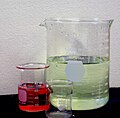 Beakers used in medical laboratories
 -
 Burette used in medical laboratories
 -
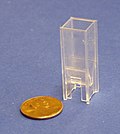 Cuvette with penny used in medical laboratories
 -
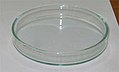 Petri dish used in medical laboratories
 -
 Pipettes used in medical laboratories
 -
 Dispensible pipette used in medical laboratories
 -
 Pasteur pipets used in medical laboratories
 -
 Erlenmeyer flasks used in medical laboratories
 -
 Spectrophotometer controls used in medical laboratories
 -
 Microtiter plate used in medical laboratories
 -
 Old light microscope used in medical laboratories


