Manganese nodule: Difference between revisions
CSV import |
CSV import |
||
| Line 28: | Line 28: | ||
[[Category:Mining]] | [[Category:Mining]] | ||
{{environment-stub}} | {{environment-stub}} | ||
<gallery> | |||
File:Manganknolle.jpg|Manganese nodule | |||
File:Konkrecje_na_dnie_oceanu.JPG|Manganese nodule on ocean floor | |||
File:Manganese_nodules.gif|Manganese nodules | |||
File:Manganese-nodule00_hg.jpg|Manganese nodule | |||
File:Konkrecje_manganowe.jpg|Manganese nodules | |||
File:2019-03-08_22-08-57_Sonne_SO268-1_035ROV06_OnlyLogo_klein_original(1).jpg|Manganese nodule | |||
</gallery> | |||
Latest revision as of 11:00, 18 February 2025
Manganese Nodule
Manganese nodules, also known as polymetallic nodules, are rock concretions on the sea bottom formed of concentric layers of iron and manganese hydroxides around a core. The core may be microfossil shells, basalt fragments, or even pieces of older nodules. These nodules are found in various sizes ranging from tiny particles visible only under a microscope to large nodules over 20 cm in diameter. They are most commonly found in the abyssal plains of the ocean, at depths of 4,000 to 6,000 meters.
Formation[edit]
The exact process of manganese nodule formation is still a subject of research, but it is believed to involve the precipitation of metals from seawater and sediment pore waters, especially in areas with slow sedimentation rates. This allows the nodules to grow over millions of years without being buried. The composition of manganese nodules varies but typically includes manganese, iron, nickel, copper, and cobalt.
Distribution[edit]
Manganese nodules are widely distributed across the global ocean, with significant concentrations found in the Clarion-Clipperton Zone (CCZ) in the Pacific Ocean, the central Indian Ocean, and parts of the Atlantic Ocean. The CCZ is particularly noted for its high abundance of large nodules.
Economic Interest[edit]
The interest in manganese nodules lies in their rich content of valuable metals such as nickel, copper, cobalt, and manganese itself. These metals are critical for various industries, including battery production, electronics, and steel manufacturing. However, the economic viability and environmental impact of mining these nodules are subjects of ongoing debate.
Environmental Concerns[edit]
Deep-sea mining for manganese nodules raises significant environmental concerns. The potential disruption of deep-sea ecosystems, sediment plumes, and the impact on biodiversity are major issues. The deep ocean is a poorly understood and fragile environment, and there is a global call for caution and extensive research before any large-scale mining operations are undertaken.
Legal and Regulatory Framework[edit]
The extraction of manganese nodules from international waters is regulated by the International Seabed Authority (ISA), established under the United Nations Convention on the Law of the Sea (UNCLOS). The ISA is responsible for regulating mineral-related activities in the international seabed area to ensure that the marine environment is protected from harmful effects that may arise from mining activities.
Research and Exploration[edit]
Ongoing research and exploration efforts aim to better understand the distribution, formation, and potential impact of mining manganese nodules. These efforts include scientific expeditions, environmental impact assessments, and the development of mining technologies that minimize environmental damage.
Conclusion[edit]
Manganese nodules hold significant economic potential due to their metal content. However, the environmental implications of their extraction are a major concern. Balancing economic interests with environmental protection remains a key challenge in the utilization of this deep-sea resource.

This article is a environment-related stub. You can help WikiMD by expanding it!
-
 Manganese nodule
 -
 Manganese nodule on ocean floor
 -
 Manganese nodules
 -
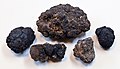 Manganese nodule
 -
 Manganese nodules
 -
 Manganese nodule


.jpg)
