Pella: Difference between revisions
CSV import |
CSV import Tags: mobile edit mobile web edit |
||
| Line 19: | Line 19: | ||
[[Category:Archaeological sites in Greece]] | [[Category:Archaeological sites in Greece]] | ||
{{history-stub}} | {{history-stub}} | ||
<gallery> | |||
File:The_main_courtyard_of_the_House_of_Dionysos,_built_in_325-300_BC,_Ancient_Pella_(6914026352).jpg|Pella | |||
File:Place_of_the_Dionysos_Mosaic_in_the_House_of_Dionysos,_built_in_325-300_BC,_Ancient_Pella_(7060180819).jpg|Pella | |||
File:0_Mosaïque_de_la_chasse_au_lion_-_Musée_archéologique_de_Pella.JPG|Pella | |||
File:Stag_Hunt_Mosaic_from_the_House_of_the_Abduction_of_Helen,_(c._300_BC),_Ancient_Pella_(6913868698).jpg|Pella | |||
File:Shops_right_along_the_eastern_edge_of_the_agora,_Ancient_Pella_(7060295407).jpg|Pella | |||
File:Plan_Pella-en.svg|Pella | |||
File:Aerial_photograph_and_plan_of_the_House_of_Dionysos,_Archaeological_Museum,_Pella_(7065301481).jpg|Pella | |||
File:Pella_baths.jpg|Pella | |||
File:Pella_leaded_tablet_(katadesmos)_4th_Century_retouched.jpg|Pella | |||
</gallery> | |||
Revision as of 12:13, 18 February 2025
Pella is an ancient city located in the current Pella regional unit of Central Macedonia, Greece. It is famous for being the historical capital of the ancient kingdom of Macedon and birthplace of Alexander the Great. Pella replaced Aigai (modern-day Vergina) as the capital of Macedon in the fourth century BC under the reign of King Philip II, Alexander the Great's father.
History
The city of Pella was founded near the ancient capital city of Aigai around the end of the 5th century BC. It became the cultural and political center of Macedon during the reign of King Philip II. The city's layout was meticulously planned, featuring a grid pattern of streets, which was innovative for its time. Pella's prosperity continued into the Hellenistic period, especially under Alexander the Great, who expanded the Macedonian empire to its greatest extent.
After Alexander's death, Pella remained an important city of the Hellenistic world but began to decline in the Roman period, especially after the Roman conquest of Greece. The city suffered significant damage during the wars of the late Roman Republic and eventually lost its status as a major urban center by the end of the 1st century BC.
Archaeological Discoveries
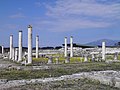
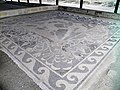
Excavations of Pella have revealed a wealth of information about ancient Macedonian culture and the Hellenistic period. Key findings include the elaborate mosaics in the floors of wealthy homes, public buildings, and marketplaces that depict various scenes from Greek mythology and daily life. These mosaics are considered some of the finest examples of Hellenistic art.
Significance
Pella is significant not only as the historical capital of Macedon but also as a key archaeological site that provides insight into the cultural and political life of ancient Macedonia. The city's sophisticated urban planning and architecture reflect the advanced level of Macedonian civilization during the reigns of Philip II and Alexander the Great.
Tourism
Today, Pella is a major archaeological site and tourist attraction. Visitors can explore the ruins of the ancient city, including the remains of the palace complex, public buildings, and residential areas. The Pella Archaeological Museum nearby houses many of the artifacts found during excavations, offering further insight into the history and culture of ancient Macedon.

-
 Pella
Pella -
 Pella
Pella -
 Pella
Pella -
 Pella
Pella -
 Pella
Pella -
Pella
-
Pella
-
Pella
-
Pella
.jpg)
.jpg)

,_Ancient_Pella_(6913868698).jpg)
.jpg)


.jpg)

_4th_Century_retouched.jpg)