World Food Prize: Difference between revisions
CSV import Tags: mobile edit mobile web edit |
CSV import Tags: mobile edit mobile web edit |
||
| Line 21: | Line 21: | ||
{{award-stub}} | {{award-stub}} | ||
<gallery> | |||
File:World_Food_Prize_logo_(2020).svg|World Food Prize | |||
File:Capitol_building,_Des_Moines,_Iowa.jpg|Capitol building, Des Moines, Iowa | |||
File:Hall_of_Laureates_-_panoramio.jpg|Hall of Laureates | |||
File:Monkombu_Sambasivan_Swaminathan_-_Kolkata_2013-01-07_2671.JPG|M. S. Swaminathan | |||
File:EdwardF.KniplingEntomologist.jpg|Edward F. Knipling | |||
File:Bezoek_Chinese_minister_van_Landbouw,_veehouderij_en_visserij_He_Kang_(r)_aan_on,_Bestanddeelnr_933-7383_(cropped).jpg|He Kang | |||
File:Muhammad_Yunus_-_World_Economic_Forum_Annual_Meeting_2012.jpg|Muhammad Yunus | |||
File:Gebisa_Ejeta_(26420838105).jpg|Gebisa Ejeta | |||
File:Dr._Maria_Andrade_(cropped).jpg|Maria Andrade | |||
File:Akinwumi_Adesina_-_2014_(cropped).jpg|Akinwumi Adesina | |||
File:Selma_Prodanovic_David_Nabarro_April_2016_(26106492653)_(cropped).jpg|David Nabarro | |||
</gallery> | |||
Latest revision as of 12:03, 18 February 2025
World Food Prize is an international award recognizing the achievements of individuals who have advanced human development by improving the quality, quantity, or availability of food in the world. Conceived in 1986 by Norman Borlaug, the father of the Green Revolution, the prize aims to highlight and encourage efforts to end global hunger and food insecurity.
History[edit]
The World Food Prize was established by Norman Borlaug in response to the successes of the Green Revolution, which significantly increased agricultural production in parts of the world, thereby reducing hunger and malnutrition. Borlaug, a Nobel Peace Prize laureate, envisioned the World Food Prize as a means to honor those who have made significant and measurable contributions to improving the world's food supply.
Award[edit]
The prize includes a $250,000 award and is presented annually in Des Moines, Iowa, a city that has become a hub for agricultural innovation and food security discussions. The selection of laureates is based on a nomination process that evaluates the impact of an individual's work on enhancing the quality, quantity, or availability of food through direct intervention or scientific breakthroughs.
Laureates[edit]
Over the years, laureates of the World Food Prize have included scientists, politicians, and activists who have implemented policies, conducted research, or led initiatives that have improved food production systems, developed new agricultural technologies, or contributed to policy changes in favor of sustainable food security. Notable laureates include Sanjaya Rajaram, a wheat breeder who developed high-yielding, disease-resistant wheat varieties, and Akinwumi Adesina, the President of the African Development Bank, recognized for his work in expanding food production in Africa.
Impact[edit]
The World Food Prize serves not only as a recognition of individual achievements but also as a platform to raise awareness about the challenges of feeding a growing global population and the importance of sustainable food systems. It fosters international cooperation and encourages further research and innovation in the field of food security and agricultural development.
Related Events[edit]
In conjunction with the award ceremony, the World Food Prize Foundation hosts the Borlaug Dialogue, an annual international symposium that brings together leaders, policymakers, and experts from around the world to discuss issues related to global food security. The event is named after Norman Borlaug and reflects his lifelong commitment to using agricultural science to feed the world's hungry.

-
World Food Prize
-
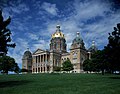 Capitol building, Des Moines, Iowa
 -
 Hall of Laureates
 -
 M. S. Swaminathan
 -
 Edward F. Knipling
 -
 He Kang
 -
 Muhammad Yunus
 -
 Gebisa Ejeta
 -
 Maria Andrade
 -
 Akinwumi Adesina
 -
 David Nabarro


_aan_on,_Bestanddeelnr_933-7383_(cropped).jpg)

.jpg)
.jpg)
.jpg)
_(cropped).jpg)

.svg)