Pleiades: Difference between revisions
CSV import |
CSV import |
||
| Line 28: | Line 28: | ||
[[Category:Mythological objects]] | [[Category:Mythological objects]] | ||
{{astronomy-stub}} | {{astronomy-stub}} | ||
<gallery> | |||
File:Pleiades large.jpg|Pleiades large | |||
File:Nebra Scheibe.jpg|Nebra Scheibe | |||
File:Seven Sisters coin Royal Australian Mint 1 dollar 2020 Reverse.jpg|Seven Sisters coin Royal Australian Mint 1 dollar 2020 Reverse | |||
File:Pleiades Sidereus Nuncius.png|Pleiades Sidereus Nuncius | |||
File:Taurus constellation map.svg|Taurus constellation map | |||
File:Astro 4D m45 cr anim.gif|Astro 4D m45 cr anim | |||
File:Stereogram guide cross-eyed.svg|Stereogram guide cross-eyed | |||
File:M45map.jpg|M45 map | |||
File:Pleiades-motion.png|Pleiades motion | |||
File:Reflection nebula IC 349 near Merope.jpg|Reflection nebula IC 349 near Merope | |||
</gallery> | |||
Latest revision as of 05:01, 3 March 2025
The Pleiades, also known as the Seven Sisters, M45, or the Maia Nebula, is an open star cluster located in the constellation of Taurus. It is among the nearest star clusters to Earth and is the cluster most obvious to the naked eye in the night sky. The cluster is dominated by hot blue and extremely luminous stars that have formed within the last 100 million years. According to the mythology of various cultures, the Pleiades represent seven sisters; in Greek mythology, they are the daughters of the titan Atlas and the sea-nymph Pleiione. The cluster is also mentioned in the literature and lore of many other cultures around the world.
Observation and Characteristics[edit]
The Pleiades cluster is composed of more than 1,000 statistically confirmed members, although only a handful are visible to the naked eye. The core radius of the cluster is about 8 light-years, and it is moving towards the constellation of Orion. With an age estimated at about 100 million years, the cluster contains many hot blue stars that are extremely luminous, making it easily visible during the winter months in the Northern Hemisphere.
Astronomers have studied the Pleiades extensively, and it has been used as a benchmark to calibrate distance scales in the universe. The cluster's distance from Earth is now accurately measured using the parallax method, placing it at approximately 444 light-years away.
Mythology and Cultural Significance[edit]
The Pleiades have a rich mythology across various cultures. In Greek mythology, they were considered to be the seven daughters of Atlas and Pleione, named Maia, Electra, Taygete, Alcyone, Celaeno, Sterope, and Merope. According to the myth, they were placed in the sky by Zeus to protect them from the pursuit of Orion.
In addition to Greek mythology, the Pleiades feature in the stories and traditions of many other cultures. For example, in Japanese culture, the cluster is known as Subaru and has been used as a symbol in the automotive brand of the same name. Native American tribes, such as the Lakota, have their own legends surrounding the Pleiades, often associating the cluster with themes of unity and brotherhood.
Scientific Exploration[edit]
The Pleiades have been the subject of scientific study for many centuries. The advent of the telescope and modern astrophysics has allowed scientists to study the cluster in detail, including its age, distance, and the physical characteristics of its stars. The cluster is also of interest because it is passing through a cloud of interstellar dust, which causes a reflection nebula visible in long-exposure photographs.
In Popular Culture[edit]
The Pleiades have inspired artists, writers, and musicians for generations. They are mentioned in the works of Homer, the Bible, and in various modern literary and musical works. The cluster's visibility and significance in the night sky have made it a symbol of beauty and mystery across different cultures and epochs.
See Also[edit]

-
 Pleiades large
 -
 Nebra Scheibe
 -
 Seven Sisters coin Royal Australian Mint 1 dollar 2020 Reverse
 -
 Pleiades Sidereus Nuncius
 -
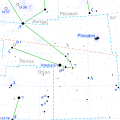 Taurus constellation map
 -
 Astro 4D m45 cr anim
 -
Stereogram guide cross-eyed
-
M45 map
-
Pleiades motion
-
Reflection nebula IC 349 near Merope


