Dendrimer: Difference between revisions
CSV import Tags: mobile edit mobile web edit |
CSV import |
||
| Line 20: | Line 20: | ||
[[Category:Nanotechnology]] | [[Category:Nanotechnology]] | ||
{{chemistry-stub}} | {{chemistry-stub}} | ||
== Dendrimer == | |||
<gallery> | |||
File:Graphs.jpg|Dendrimer | |||
File:Dendrimer_ChemEurJ_2002_3858.jpg|Dendrimer | |||
File:Cyanostar_STM.png|Dendrimer | |||
File:Dendrimer_DA_Mullen_1996.svg|Dendrimer | |||
File:538_Gene_delivery.png|Dendrimer | |||
</gallery> | |||
Latest revision as of 04:52, 18 February 2025

Dendrimers are a unique class of synthetic macromolecules characterized by their highly branched, tree-like structures. The term "dendrimer" originates from the Greek words dendron, meaning tree, and meros, meaning part. These nano-sized polymers are constructed from a central core, from which multiple layers (generations) of branches emanate. Each successive generation increases the complexity and size of the dendrimer, leading to a well-defined, monodisperse structure with numerous terminal functional groups.
Structure and Synthesis[edit]
The synthesis of dendrimers can be achieved through two primary methods: divergent synthesis and convergent synthesis. In divergent synthesis, the process begins from the core and proceeds outward, adding branches in a stepwise fashion to build up the dendrimer structure. This method was first introduced by Tomalia et al. in the early 1980s. Conversely, convergent synthesis starts from the outermost branches and proceeds inward, with the branches being constructed first and then attached to the core. This approach, developed by Hawker and Fréchet, allows for greater control over the final structure's uniformity and functionality.
Applications[edit]
Dendrimers have found applications across a broad range of fields due to their unique properties, such as their monodispersity, high degree of branching, and numerous terminal functional groups. Some of the key areas include:
- Drug Delivery: Dendrimers can encapsulate or conjugate therapeutic agents, improving solubility, stability, and bioavailability while also allowing for targeted delivery and controlled release.
- Diagnostic Imaging: The ability to functionalize dendrimers with imaging agents makes them useful in enhancing the contrast of magnetic resonance imaging (MRI) and other imaging modalities.
- Catalysis: Dendrimers can act as nanoscale reactors, providing a unique environment for catalytic reactions due to their well-defined structure and the ability to localize catalytic sites at their periphery or core.
- Material Science: The application of dendrimers in the creation of advanced materials, including light-emitting diodes (LEDs), solar cells, and sensors, is an area of growing interest.
Challenges and Future Directions[edit]
Despite their potential, the widespread application of dendrimers is hampered by challenges related to their synthesis and scalability. The precise control required in the synthesis of dendrimers, especially at higher generations, can be complex and time-consuming. Additionally, the cost of production is a significant barrier to their commercialization.
Future research is directed towards developing more efficient synthetic strategies, understanding and improving the biocompatibility of dendrimers, and exploring new applications in nanotechnology, medicine, and materials science.

Dendrimer[edit]
-
 Dendrimer
 -
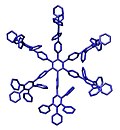 Dendrimer
 -
 Dendrimer
 -
 Dendrimer
 -
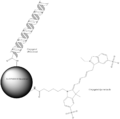 Dendrimer


