Centaurea montana: Difference between revisions
CSV import |
CSV import |
||
| Line 26: | Line 26: | ||
[[Category:Garden plants]] | [[Category:Garden plants]] | ||
{{botany-stub}} | {{botany-stub}} | ||
<gallery> | |||
File:Centaurea_montana.jpg|Centaurea montana | |||
File:Centaura_de_las_montañas_-_Centaurea_montana_(9583677454).jpg|Centaurea montana | |||
</gallery> | |||
Latest revision as of 02:03, 18 February 2025

Centaurea montana, commonly known as mountain cornflower, perennial cornflower, or mountain bluet, is a species of flowering plant in the family Asteraceae. It is native to the European mountains, including the Alps and Pyrenees, where it thrives in meadow and woodland areas. This species is appreciated for its striking blue flowers and is often cultivated in gardens and parks across temperate regions worldwide.
Description[edit]
Centaurea montana is a herbaceous perennial plant that typically grows to a height of 30–70 cm. Its leaves are lanceolate to ovate, with the basal leaves being larger and petiolate, while the upper leaves are smaller and sessile. The plant is easily recognized by its vivid blue flowers, which are actually a combination of blue florets surrounded by involucral bracts that have a distinctive fringed appearance. The flowers bloom from late spring to early summer, providing a splash of color in garden settings.
Habitat and Distribution[edit]
Originally from the mountainous regions of Europe, Centaurea montana has a preference for well-drained soils and can often be found in meadows, forest clearings, and grassy slopes. It has adapted well to various environmental conditions outside its native range and can be found in many temperate gardens and naturalized areas around the world.
Cultivation and Uses[edit]
Centaurea montana is valued in horticulture for its striking blue flowers and its ability to attract pollinators such as bees and butterflies. It prefers full sun to partial shade and thrives in well-drained soil. Once established, it is relatively drought-tolerant and low-maintenance, making it a popular choice for gardeners. In addition to its ornamental use, Centaurea montana has been used in traditional medicine, although scientific evidence supporting its efficacy is limited.
Varieties and Hybrids[edit]
Several cultivars and hybrids of Centaurea montana have been developed to offer a range of flower colors, including white (Centaurea montana 'Alba') and pink (Centaurea montana 'Carnea'). These cultivars provide additional options for gardeners looking to incorporate mountain cornflower into their landscapes.
Conservation[edit]
While Centaurea montana is not currently listed as endangered, its natural habitats in the wild are subject to the pressures of agricultural expansion, urbanization, and climate change. Conservation efforts are important to ensure that this species and its natural habitats are preserved for future generations.
See Also[edit]
-
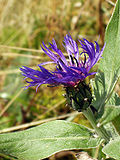 Centaurea montana
 -
 Centaurea montana
.jpg)

