Gibbsite: Difference between revisions
CSV import |
CSV import |
||
| Line 21: | Line 21: | ||
{{geology-stub}} | {{geology-stub}} | ||
<gallery> | |||
File:Gibbsite-fiu14a.jpg|Gibbsite | |||
File:Gibbsite-crystal-3D-balls.png|Gibbsite crystal structure | |||
File:Gibbsite-270400.jpg|Gibbsite | |||
</gallery> | |||
Revision as of 02:03, 18 February 2025

Gibbsite is a mineral, one of the three component minerals of the economically important aluminum ore Bauxite. Gibbsite is an aluminum hydroxide (Al(OH)3) mineral that was first discovered in 1820 by Chester Dewey (1784–1867) of Williams College, Massachusetts. It was named after George Gibbs (1776–1833), a mineralogist who first analyzed its composition. Gibbsite has a monoclinic crystal system and is typically found in pisolitic, earthy, or crusty forms. It is white to gray in color, though impurities can give it a yellow or red hue.
Properties and Formation
Gibbsite has a Mohs hardness of 2.5 to 3.5, which makes it relatively soft. It has a specific gravity of about 2.34 to 2.4, which is considered light for a mineral. Gibbsite forms under high pH conditions in the soil, where aluminum is leached from silicate minerals and re-precipitates as gibbsite in the presence of water. This process is common in tropical and subtropical regions where high rainfall rates lead to intense weathering of the bedrock.
Occurrence
Gibbsite is found in a variety of geological settings. It is most commonly associated with Bauxite deposits, which are formed from the intense weathering of aluminum-rich rocks in tropical and subtropical climates. Gibbsite can also occur as a secondary mineral in hydrothermal systems and as a weathering product of other aluminum-bearing minerals.
Economic Importance
Gibbsite is of significant economic importance as it is one of the main sources of aluminum. Bauxite, which often contains a high percentage of gibbsite, is mined extensively in countries such as Australia, China, Brazil, India, and Guinea. The aluminum extracted from gibbsite and other bauxite minerals is used in a wide range of products, from aircraft and automobiles to kitchen utensils and packaging materials.
Synthetic Gibbsite
In addition to its natural occurrence, gibbsite can also be synthesized in the laboratory. Synthetic gibbsite is produced for various industrial applications, including as a raw material in the production of aluminum metal and as a component in certain types of catalysts and chemicals.
Environmental Considerations
The mining and processing of gibbsite-bearing bauxite can have significant environmental impacts. These include deforestation, soil erosion, and contamination of water sources with red mud, a byproduct of the Bayer process used to extract aluminum from bauxite. Efforts are being made in the industry to manage these impacts through improved mining practices and the development of more sustainable processing technologies.

-
 Gibbsite
 -
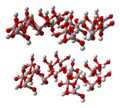 Gibbsite crystal structure
 -
Gibbsite


