List of vaginal tumors: Difference between revisions
CSV import |
CSV import |
||
| Line 46: | Line 46: | ||
{{Medicine-stub}} | {{Medicine-stub}} | ||
<gallery> | |||
File:Mixed germ cell tumour - high mag.jpg|List of vaginal tumors | |||
File:PNET Histopathology HE 200x.jpg|List of vaginal tumors | |||
File:SkinTumors-456.jpg|List of vaginal tumors | |||
File:Small cell lung cancer - cytology.jpg|List of vaginal tumors | |||
File:Tubular adenoma 2 intermed mag.jpg|List of vaginal tumors | |||
File:SkinTumors-P9250819.jpg|List of vaginal tumors | |||
</gallery> | |||
Latest revision as of 01:20, 20 February 2025
Vaginal Tumors encompass a range of benign and malignant growths that occur within the vagina, a muscular tube connecting the external genitals to the uterus. The types, symptoms, diagnosis, and treatment of vaginal tumors vary depending on the specific nature of the tumor.
Types of Vaginal Tumors[edit]
Vaginal tumors can be classified into benign (non-cancerous) and malignant (cancerous) types.
Benign Tumors[edit]
- Vaginal Polyps: Small, usually benign growths attached to the vaginal wall by a thin stalk.
- Fibroids: Non-cancerous tumors that can develop in and around the vagina, though they are more common in the uterus.
- Cysts: Fluid-filled sacs that can form in the vaginal wall.
Malignant Tumors[edit]
- Vaginal Cancer: A rare form of cancer that forms in the vaginal tissues. It is more common in women over age 60.
- Squamous Cell Carcinoma: The most common type of vaginal cancer, originating in the thin, flat cells lining the vagina.
- Adenocarcinoma: Begins in the glandular cells of the vagina.
- Melanoma: A type of cancer that forms in the pigment-producing cells in the vaginal mucosa.
- Sarcoma: Starts in the muscle or connective tissue of the vagina and is more common in children and adolescents.
Symptoms[edit]
Symptoms of vaginal tumors may include:
- Abnormal vaginal bleeding or discharge
- A lump or mass in the vagina
- Pain during intercourse
- Pelvic pain
It is important to note that benign tumors may not cause any symptoms and are often discovered during routine gynecological examinations.
Diagnosis[edit]
Diagnosis of vaginal tumors involves a combination of:
- Pelvic Examination: To check for any abnormalities.
- Pap Test: To detect precancerous or cancerous cells.
- Biopsy: A procedure to remove a small sample of tissue for laboratory analysis.
- Imaging Tests: Such as MRI or CT scans to determine the extent of the tumor.
Treatment[edit]
Treatment options for vaginal tumors depend on the type, size, and stage of the tumor, as well as the patient's overall health. They may include:
- Surgery: To remove the tumor.
- Radiation Therapy: To destroy cancer cells.
- Chemotherapy: The use of drugs to kill cancer cells.
Prevention and Screening[edit]
Regular gynecological exams and Pap tests can help detect vaginal tumors at an early stage. HPV vaccination is also recommended to prevent HPV infections, which are associated with the development of vaginal and other genital cancers.

-
 List of vaginal tumors
 -
 List of vaginal tumors
 -
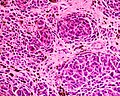 List of vaginal tumors
 -
 List of vaginal tumors
 -
 List of vaginal tumors
 -
 List of vaginal tumors


