Isomer (Proarticulata): Difference between revisions
CSV import |
CSV import Tags: mobile edit mobile web edit |
||
| Line 23: | Line 23: | ||
[[Category:Prehistoric life]] | [[Category:Prehistoric life]] | ||
{{Paleontology-stub}} | {{Paleontology-stub}} | ||
<gallery> | |||
File:Yorgia.jpg|Yorgia, a genus of the extinct phylum Proarticulata | |||
File:DickinsoniaCostata3.png|Dickinsonia costata, a species of the extinct phylum Proarticulata | |||
File:Proarticulata_Classes.jpg|Diagram showing classes within the phylum Proarticulata | |||
</gallery> | |||
Latest revision as of 02:12, 18 February 2025
Isomer is a genus within the extinct phylum Proarticulata, a group of early multicellular organisms that thrived during the Ediacaran period, approximately 635 to 541 million years ago. The Proarticulata are characterized by their unique body plan, which exhibits bilateral symmetry in a segmented fashion, but unlike the true bilateral symmetry seen in most modern animals, their segments are mirrored across a central axis in a glide reflection manner. This means that the segments on one side of the body are offset from those on the other, creating a unique form of symmetry.
Description[edit]
Isomer, like other members of the Proarticulata, had a body plan that is distinct from any living organisms. The fossil records indicate that Isomer possessed a series of repetitive body segments that increased in size from one end of the organism to the other. Each segment was adorned with a series of ridges or annulations, which may have played a role in locomotion or interaction with the sedimentary environment in which it lived. The overall morphology of Isomer suggests it was a benthic organism, living in close association with the sea floor.
Taxonomy and Phylogeny[edit]
The classification of Isomer within the Proarticulata is based on its unique body plan and segmentation pattern, which is distinct from that of other known Ediacaran biota. The Proarticulata are considered to be among the earliest examples of complex multicellular life, and their exact place in the tree of life is a subject of ongoing research and debate. Some scientists propose that they represent an early, separate lineage of multicellular organisms that diverged before the common ancestor of modern animals, while others suggest they may be more closely related to specific modern groups.
Ecology[edit]
The ecological role of Isomer during the Ediacaran period is not fully understood, but it is believed to have been a sessile or slowly moving organism that lived on the sea floor. Its body plan suggests it may have been adapted to a specific niche, possibly feeding through absorption or filtering of nutrients from the water or sediment. The presence of Isomer and other Proarticulata in the fossil record provides evidence of the diversity of life and the complexity of ecosystems during the Ediacaran period.
Fossil Record[edit]
Fossils of Isomer have been found in various locations around the world, including Russia, Australia, and Newfoundland, which are known for their well-preserved Ediacaran faunas. These fossils provide valuable insights into the morphology, distribution, and diversity of Proarticulata, contributing to our understanding of early multicellular life on Earth.
See Also[edit]

This article is a paleontology stub. You can help WikiMD by expanding it!
-
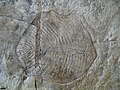 Yorgia, a genus of the extinct phylum Proarticulata
 -
 Dickinsonia costata, a species of the extinct phylum Proarticulata
 -
 Diagram showing classes within the phylum Proarticulata


