Nanoparticles for drug delivery to the brain: Difference between revisions
CSV import |
CSV import |
||
| Line 37: | Line 37: | ||
{{Medicine-stub}} | {{Medicine-stub}} | ||
== Nanoparticles for drug delivery to the brain == | |||
<gallery> | |||
File:Liposome_scheme-en.svg|Diagram of a liposome structure | |||
File:SolidLipidNanoparticle.jpg|Solid lipid nanoparticle | |||
File:Polymer_Branch.svg|Polymer branch structure | |||
File:Blood-brain_barrier_transport_en.png|Blood-brain barrier transport mechanisms | |||
</gallery> | |||
Latest revision as of 05:04, 18 February 2025
Nanoparticles for Drug Delivery to the Brain
Nanoparticles for drug delivery to the brain represent a cutting-edge approach in the field of pharmacology and nanomedicine, aiming to overcome the challenges associated with delivering therapeutic agents across the Blood-Brain Barrier (BBB) efficiently. The BBB is a highly selective semipermeable border that separates the circulating blood from the brain and extracellular fluid in the central nervous system (CNS). This barrier is crucial for brain protection but also poses significant obstacles for drug delivery due to its restrictive permeability.
Overview[edit]
The use of nanoparticles for drug delivery to the brain involves the engineering of tiny, often nanoscale, particles that can carry therapeutic agents and traverse the BBB to reach their target sites within the CNS. These nanoparticles are designed to encapsulate drugs, thereby protecting them from degradation, improving their solubility, and enhancing their delivery to the brain. Various materials, including liposomes, polymeric nanoparticles, solid lipid nanoparticles, and dendrimers, have been explored for this purpose.
Types of Nanoparticles[edit]
Liposomes[edit]
Liposomes are spherical vesicles consisting of one or more phospholipid bilayers. They can encapsulate both hydrophilic and hydrophobic drugs, offering a versatile platform for drug delivery to the brain.
Polymeric Nanoparticles[edit]
Polymeric nanoparticles are made from biodegradable polymers such as PLGA (polylactic-co-glycolic acid). They are particularly useful for controlled drug release and have shown promise in targeting specific areas within the brain.
Solid Lipid Nanoparticles[edit]
Solid lipid nanoparticles (SLNs) are composed of solid lipids and offer advantages such as high drug loading capacity and stability. They are considered an alternative to liposomes and polymeric nanoparticles.
Dendrimers[edit]
Dendrimers are highly branched, tree-like structures. Their size and surface functionality can be precisely controlled, making them suitable for targeted drug delivery applications.
Mechanisms of Crossing the BBB[edit]
Several strategies have been employed to facilitate the transport of nanoparticles across the BBB, including:
- Receptor-Mediated Transcytosis: Utilizing nanoparticles that can bind to specific receptors on the BBB, thereby triggering their transport across the barrier.
- Adsorptive-Mediated Transcytosis: Involves the adsorption of nanoparticles onto the BBB surface, followed by their transcytosis.
- Cell-Penetrating Peptides: These peptides can facilitate the delivery of nanoparticles by enhancing their penetration through the BBB.
Applications[edit]
Nanoparticles for drug delivery to the brain have potential applications in treating a wide range of neurological disorders, including Alzheimer's disease, Parkinson's disease, brain tumors, and multiple sclerosis. By enabling targeted delivery of therapeutics, nanoparticles can potentially increase drug efficacy and reduce side effects.
Challenges and Future Directions[edit]
Despite the promising aspects of nanoparticles for brain drug delivery, several challenges remain, such as ensuring the biocompatibility and safety of nanoparticles, achieving precise targeting, and controlling drug release rates. Ongoing research is focused on addressing these issues, with the ultimate goal of developing effective nanoparticle-based therapies for CNS disorders.

Nanoparticles for drug delivery to the brain[edit]
-
 Diagram of a liposome structure
 -
 Solid lipid nanoparticle
 -
 Polymer branch structure
 -
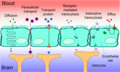 Blood-brain barrier transport mechanisms


