Feathery degeneration: Difference between revisions
CSV import Tags: mobile edit mobile web edit |
CSV import |
||
| Line 32: | Line 32: | ||
{{Medicine-stub}} | {{Medicine-stub}} | ||
<gallery> | |||
File:Feathery_degeneration_high_mag_cropped.jpg|Feathery degeneration high magnification cropped | |||
File:Feathery_degeneration_high_mag.jpg|Feathery degeneration high magnification | |||
</gallery> | |||
Latest revision as of 01:34, 18 February 2025
Feathery degeneration is a pathological condition observed in the liver, characterized by a distinctive morphological change in hepatocytes, the liver's primary cells. This condition is often associated with certain liver diseases, particularly those involving cholestasis, where there is an impairment or cessation of bile flow. Feathery degeneration is so named because of the feathery or frothy appearance of the cytoplasm of affected hepatocytes under microscopic examination. This appearance is due to the accumulation of bile salts within the cytoplasm.
Etiology[edit]
Feathery degeneration is primarily seen in conditions that lead to cholestasis, such as:
- Primary biliary cirrhosis
- Primary sclerosing cholangitis
- Drug-induced liver injury
- Hepatitis
- Genetic disorders affecting bile secretion
Pathophysiology[edit]
The pathogenesis of feathery degeneration involves the accumulation of bile acids within hepatocytes, which is a direct consequence of cholestasis. Bile acids, which are normally secreted into the bile canaliculi, accumulate in the liver when there is an obstruction to bile flow or when bile secretion is impaired. This accumulation causes cellular stress and damage, leading to the characteristic feathery appearance of hepatocytes. The affected cells show swollen, pale cytoplasm with a foamy texture, due to the presence of fine, granular bile salts.
Clinical Significance[edit]
Feathery degeneration is an important histological marker for diagnosing liver diseases associated with cholestasis. It indicates the presence of intrahepatic bile stasis, which can have various underlying causes. Identifying feathery degeneration can help in the differential diagnosis of liver conditions and guide appropriate treatment strategies.
Diagnosis[edit]
The diagnosis of feathery degeneration is made through histological examination of liver biopsy specimens. Liver biopsy is a procedure where a small sample of liver tissue is collected and examined under a microscope. In cases of feathery degeneration, the pathologist looks for the characteristic changes in hepatocytes described above.
Treatment[edit]
Treatment of feathery degeneration focuses on addressing the underlying cause of cholestasis. This may involve:
- Medications to improve bile flow, such as ursodeoxycholic acid for conditions like primary biliary cirrhosis
- Treatment of liver infections or inflammations
- Avoidance of drugs known to cause liver injury
- In severe cases, liver transplantation may be considered
Prognosis[edit]
The prognosis of feathery degeneration largely depends on the underlying cause and the extent of liver damage at the time of diagnosis. Early detection and treatment of the causative condition can improve outcomes.

-
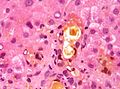 Feathery degeneration high magnification cropped
 -
 Feathery degeneration high magnification


