Split (gymnastics): Difference between revisions
CSV import Tags: mobile edit mobile web edit |
CSV import |
||
| Line 26: | Line 26: | ||
{{Gymnastics-stub}} | {{Gymnastics-stub}} | ||
<gallery> | |||
File:Szpagat_poprzeczny.jpg|Split (gymnastics) | |||
File:Kalarickal_ayurveda_praveen_yoga.jpg|Split (gymnastics) | |||
File:Shawn_Sawyer_Spin_-_2006_Skate_Canada.jpg|Split (gymnastics) | |||
File:Överspagat.jpg|Split (gymnastics) | |||
File:Fuori_asse_alla_seconda.jpg|Split (gymnastics) | |||
File:SplitLeap.gif|Split (gymnastics) | |||
File:12_-_Flickr_-_Eye_Steel_Film.jpg|Split (gymnastics) | |||
File:55_-_Flickr_-_Eye_Steel_Film.jpg|Split (gymnastics) | |||
</gallery> | |||
Latest revision as of 11:20, 18 February 2025
Split (gymnastics) is a physical position in which the legs are in line with each other and extended in opposite directions. Splits are commonly performed in various athletic and dance disciplines, including gymnastics, dance, figure skating, and martial arts. In gymnastics, splits are a fundamental element, showcasing flexibility, balance, and control. There are several types of splits, including the front split, side split (also known as the straddle split), and over split.
Types of Splits[edit]
Front Split[edit]
The front split is executed by extending one leg forward and the other leg backward, both legs straight, with the pelvis facing forward. This split is also known as a linear split or Chinese split. It demonstrates flexibility in the hamstrings of the front leg and hip flexors of the back leg.
Side Split[edit]
The side split or straddle split involves spreading the legs to the side as wide as possible, with the pelvis facing forward or downward. This type of split emphasizes the flexibility of the inner thigh muscles or adductors.
Over Split[edit]
An over split is a more advanced version of the split where one or both feet are elevated, increasing the angle and stretch beyond 180 degrees. Over splits require significant flexibility and are often seen in advanced gymnastics, dance, and cheerleading.
Training and Flexibility[edit]
Achieving a split requires consistent training and stretching to increase flexibility in the muscles and ligaments. Stretching exercises specific to the hamstrings, hip flexors, and adductors are essential for developing the necessary flexibility. It is important to warm up properly before stretching to prevent injuries.
In Gymnastics[edit]
In gymnastics, splits are not only a basic skill but also a component of various elements and routines, including floor exercises and balance beam routines. Gymnasts must often perform splits with precision and control, maintaining alignment and posture.
Safety Considerations[edit]
While training for splits, it is crucial to listen to one's body and avoid pushing too hard, as this can lead to muscle strains or more serious injuries. Proper technique and gradual progression are key to safely achieving and improving splits.
_pictogram_2.svg)
-
 Split (gymnastics)
 -
 Split (gymnastics)
 -
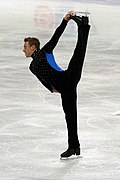 Split (gymnastics)
 -
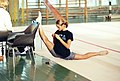 Split (gymnastics)
 -
 Split (gymnastics)
 -
 Split (gymnastics)
 -
 Split (gymnastics)
 -
 Split (gymnastics)


