Persecution of Uyghurs in China: Difference between revisions
CSV import |
CSV import |
||
| Line 29: | Line 29: | ||
{{Human rights-stub}} | {{Human rights-stub}} | ||
== Persecution of Uyghurs in China == | |||
<gallery> | |||
File:Xinjiang_Re-education_Camp_Lop_County.jpg|Xinjiang Re-education Camp Lop County | |||
File:Uyghur_man_in_Kashgar.jpg|Uyghur man in Kashgar | |||
File:Map_of_Xinjiang_in_China,_with_Prefectures_and_borders.png|Map of Xinjiang in China, with Prefectures and borders | |||
File:Xinjiang-police-jobs.png|Xinjiang police jobs | |||
File:Number_of_re-education_related_government_procurement_bids_in_Xinjiang.svg|Number of re-education related government procurement bids in Xinjiang | |||
File:Mihrigul_Tursun.jpg|Mihrigul Tursun | |||
File:Collage_sur_un_mur_à_Bordeaux_(France).jpg|Collage sur un mur à Bordeaux (France) | |||
File:Mosque_in_Tuyoq_02.jpg|Mosque in Tuyoq | |||
</gallery> | |||
Latest revision as of 23:54, 24 February 2025
Persecution of Uyghurs in China refers to the series of actions taken by the Chinese government and its agencies against the Uyghur people, a Turkic ethnic minority group native to the Xinjiang Uyghur Autonomous Region in Northwest China. The persecution has included, but is not limited to, mass surveillance, detention in re-education camps, forced labor, religious oppression, and cultural assimilation. International organizations and human rights groups have described these actions as part of a broader campaign of genocide and crimes against humanity.
Background[edit]
The Uyghurs are a predominantly Muslim ethnic group, with a rich cultural history and strong ties to Central Asia. The tension between the Uyghurs and the Chinese government has historical roots, dating back to the incorporation of Xinjiang into the Qing Dynasty in the 18th century. In recent decades, the Chinese government has intensified its control over the region, citing concerns over separatism, terrorism, and religious extremism.
Re-education Camps[edit]
One of the most controversial aspects of the persecution is the establishment of what the Chinese government calls "Vocational Education and Training Centers." These facilities have been reported to detain up to a million Uyghurs and other Muslim minorities without trial. Detainees are subjected to political indoctrination, forced to renounce their religion and culture, and in some cases, subjected to torture and sexual abuse.
Surveillance and Control[edit]
The Chinese government has implemented an extensive surveillance system in Xinjiang, including facial recognition cameras, mandatory spyware on personal devices, and checkpoints throughout the region. This system is designed to monitor the movements and behaviors of the Uyghur population, restricting their freedom and punishing any signs of dissent.
Forced Labor[edit]
Reports have emerged of Uyghurs being forced into labor in factories within Xinjiang and other parts of China. These practices have raised concerns about the complicity of international brands and supply chains in human rights abuses.
International Response[edit]
The international community has responded to the persecution of Uyghurs with condemnation, sanctions, and calls for investigations. However, China denies any wrongdoing, framing its actions in Xinjiang as necessary measures against terrorism and for economic development.
See Also[edit]
This human rights related article is a stub.
Persecution of Uyghurs in China[edit]
-
Xinjiang Re-education Camp Lop County
-
 Uyghur man in Kashgar
 -
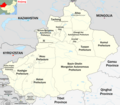 Map of Xinjiang in China, with Prefectures and borders
 -
 Xinjiang police jobs
 -
 Number of re-education related government procurement bids in Xinjiang
 -
 Mihrigul Tursun
 -
 Collage sur un mur à Bordeaux (France)
 -
 Mosque in Tuyoq


.jpg)


