Dog coat genetics: Difference between revisions
CSV import Tags: mobile edit mobile web edit |
CSV import |
||
| Line 35: | Line 35: | ||
{{Genetics-stub}} | {{Genetics-stub}} | ||
<gallery> | |||
File:Dog_coat_variation.png|Dog coat genetics | |||
File:Labrador_Rüde.jpg|Dog coat genetics | |||
File:MG_3867_Joucas_20090418.jpg|Dog coat genetics | |||
File:Adult_Male_Weimeraner_on_the_Prowl_2.jpg|Dog coat genetics | |||
File:Silver_Labrador_Retriever_Cooper.jpg|Dog coat genetics | |||
File:Can_Setter_dog_GFDL.jpg|Dog coat genetics | |||
File:Poil_agouti.svg|Dog coat genetics | |||
File:Greyhound_fur_brindle.jpg|Dog coat genetics | |||
File:Eurasier_BailyWtatze.jpg|Dog coat genetics | |||
File:Eurasian_wolf_2.jpg|Dog coat genetics | |||
File:Black_&_Tan_kelpie_2.png|Dog coat genetics | |||
File:Australien_Kelpie_2.jpg|Dog coat genetics | |||
</gallery> | |||
Latest revision as of 12:13, 18 February 2025
Dog Coat Genetics refers to the study of the genetic mechanisms that determine the coat color, texture, and pattern in dogs. This field combines principles from genetics, molecular biology, and veterinary science to understand how different genes interact to produce the wide variety of dog coat appearances.
Genetics of Dog Coat Color[edit]
The color of a dog's coat is primarily determined by two pigments: eumelanin (black) and pheomelanin (red). The specific color and pattern seen in a dog's coat are the result of the interaction between various genes. The main genes involved include:
- MC1R (E locus): Determines whether the coat will express eumelanin (black) or pheomelanin (red/yellow). Mutations in this gene can lead to a black, chocolate, or yellow coat.
- ASIP (A locus): Influences the distribution of eumelanin and pheomelanin, leading to patterns such as agouti, sable, and tan points.
- TYRP1 (B locus): Affects the intensity of the eumelanin pigment, resulting in black or brown coats.
- MLPH (D locus): Controls the dilution of the eumelanin and pheomelanin pigments, leading to colors like blue and lilac.
- S locus: Associated with the presence of white spotting patterns on the coat.
Texture and Length[edit]
The texture and length of a dog's coat are influenced by several genes, including:
- FGF5: Controls the length of the hair, with mutations leading to long-haired phenotypes in breeds that are typically short-haired.
- RSPO2: Associated with the development of wire-haired textures in certain breeds.
- KRT71: Mutations in this gene can lead to curly coats.
Pattern and Markings[edit]
Distinct patterns and markings in dog coats, such as brindle, merle, and harlequin, are governed by specific genetic mechanisms:
- K locus (KB allele): Dominant black, which can suppress other color patterns.
- Merle (M locus): Causes a mottled or dappled coat pattern, affecting both color and pigmentation intensity.
- Harlequin (H locus): Works in conjunction with the merle gene to produce a pattern of large patches, typically seen in Great Danes.
Health Implications[edit]
Certain coat colors and patterns are associated with health issues. For example, dogs with the merle or piebald patterns may have an increased risk of hearing and vision problems. It is important for breeders to consider these potential health implications when breeding dogs for specific coat characteristics.
Breeding and Genetics[edit]
Understanding the genetics of dog coat color and texture is crucial for breeders who aim to produce dogs with specific appearances while minimizing the risk of health problems. Genetic testing can help identify carriers of specific alleles, allowing for informed breeding decisions.

-
 Dog coat genetics
 -
 Dog coat genetics
 -
 Dog coat genetics
 -
 Dog coat genetics
 -
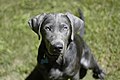 Dog coat genetics
 -
 Dog coat genetics
 -
 Dog coat genetics
 -
 Dog coat genetics
 -
 Dog coat genetics
 -
 Dog coat genetics
 -
 Dog coat genetics
 -
 Dog coat genetics


